
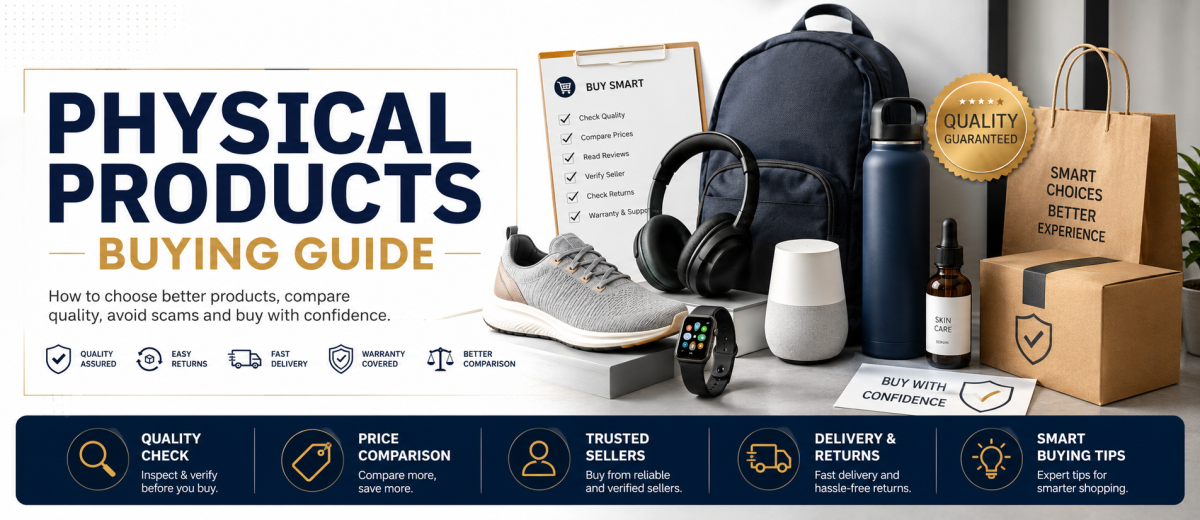
Physical products are the things people actually hold, use, wash, wear, cook with, sit on, build with, gift to others and depend on every day. A physical product can be a kitchen appliance, a backpack, a chair, a baby stroller, a mattress, a water bottle, a tool set, a pair of shoes, a storage box, a skincare device, a toy, a fitness item, a home improvement product or a simple household essential. Unlike a digital subscription, a physical product has weight, material, size, delivery risk, breakage risk, safety concerns, maintenance needs and return complications. That is why buying physical products online requires a different level of attention.
Many shoppers think the hard part is finding the lowest price. In reality, the best purchase is rarely the cheapest listing. A good purchase is the product that fits your real need, arrives as described, is safe to use, lasts long enough to justify the cost, has clear warranty support and does not create trouble after delivery. A poor purchase can waste money even when it looks like a discount. It may be the wrong size, made from weak material, unsafe for children, incompatible with your space, expensive to return, hard to assemble, difficult to clean or impossible to repair.
This complete physical products buying guide is written for global readers who want to buy smarter, safer and with more confidence. It explains how to compare products, check authenticity, read specifications, understand materials, review seller trust, inspect deliveries, avoid unsafe items, handle returns, calculate real cost and choose the best option for your situation. It is not about one product only. It is a practical A-Z guide for nearly every physical product category you may buy online or offline.

1. What Makes Physical Product Buying Different?
Physical products are different from digital products because they must be manufactured, packaged, shipped, handled, stored and used in real environments. A chair must support weight. A backpack must survive daily movement. A blender must handle heat, liquid and electricity. A toy must not create choking or chemical risks. A mattress must match body comfort and room size. A pair of shoes must fit both the foot and the activity. These details are harder to judge from photos alone.
Online photos can hide scale, texture, stitching quality, thickness, weight and durability. A product image may make a small item look premium. A listing may use lifestyle photos that do not show the actual size. Reviews may praise fast delivery but say little about long-term use. Some sellers copy photos from other brands. Some products look identical but use different materials inside. This is why physical product buying requires a checklist-based approach.
The most useful question is not “Is this product popular?” The better question is “Will this product solve my problem safely and reliably in my environment?” A kitchen shelf may be excellent for a dry apartment but weak in a humid area. A white sofa may look elegant but be impractical in a home with children or pets. A cheap luggage set may be fine for one local trip but fail during international travel. A fashionable shoe may not be good for daily walking. Context matters.
2. Start With the Real Use Case
Before comparing brands, colors or discounts, write down the real use case. This sounds simple, but it prevents many buying mistakes. A user who needs a backpack for school has different priorities from a user who needs a backpack for hiking, business travel or camera equipment. A user buying a table for occasional laptop work has different needs from someone who works eight hours a day. A user buying cookware for induction cooking must check different details from someone using a gas stove.
A clear use case should include who will use the product, how often it will be used, where it will be used, how much space is available, what problems it must solve, what risks must be avoided and what budget range is realistic. For example, “I need a lightweight carry-on suitcase for international flights, 3 to 5 trips per year, durable wheels, not too heavy, accepted by major airlines and easy to store.” This is much stronger than “I need a good suitcase.”
When the use case is clear, product comparison becomes easier. You stop getting distracted by unnecessary features. You can ignore products designed for a different buyer. You can judge reviews more accurately. If a negative review says a storage box is too small, that matters only if you need large storage. If a shoe review says it is too narrow, that matters if your feet are wide. If a chair review says assembly takes time, that matters if you cannot use tools or do not want assembly work.
3. The Physical Product Buying Framework
A reliable buying decision usually comes from five areas: need fit, product quality, seller trust, delivery practicality and after-sales protection. If one of these areas is weak, the purchase becomes risky. A product can be high quality but useless if it does not fit your need. A seller can be cheap but risky if returns are unclear. A product can be beautiful but frustrating if it is hard to clean or maintain.
| Buying Area | What to Check | Why It Matters | Red Flag |
|---|---|---|---|
| Need Fit | Size, function, frequency of use, environment, user type | A product must match your real life, not just the listing photo. | No clear measurements or vague usage claims |
| Quality | Material, construction, weight, finish, durability, safety labels | Quality affects lifespan, comfort, safety and total cost. | No material details or only marketing words |
| Seller Trust | Seller history, reviews, support, return policy, business information | A good seller can solve problems if delivery or quality fails. | New seller with copied images and unrealistic prices |
| Delivery | Shipping time, packaging, damage risk, customs, delivery method | Large or fragile items can become expensive if delivery goes wrong. | No tracking, unclear shipping origin or high return shipping |
| After-Sales | Warranty, refund window, replacement parts, repair support | Good protection reduces loss if the product is defective. | No warranty or return information |
4. How to Check Product Quality Before Buying
Quality is not only about brand name. A less famous brand can make a good product, and a famous brand can sell an overpriced item. Quality comes from materials, design, manufacturing control, finishing, testing and support. Since shoppers cannot physically inspect online products before purchase, they must read details carefully and compare evidence.
Start with material information. For clothing, check fabric composition, stitching details, lining and care instructions. For bags, check material type, zipper quality, handle reinforcement and weight capacity. For furniture, check frame material, board thickness, joint type, finish, weight limit and assembly requirements. For kitchen products, check food-safe materials, heat resistance, dishwasher safety and whether coatings are durable. For children’s products, safety labels, age recommendations and small-part warnings are critical.
Look for real measurements, not only words like “large,” “premium,” “strong” or “heavy duty.” A shelf should list width, height, depth and maximum load. A suitcase should list external dimensions and weight. A storage box should list volume. A mattress should list thickness and firmness description. A table should list tabletop size, height and material. When measurements are missing, the seller is asking you to guess, and guessing creates returns.
Product weight can also reveal quality. Very lightweight may be good for travel gear, but suspicious for furniture, tools or metal products. A “stainless steel” product that is too light may be thin and weak. A “wooden” product may be MDF or particle board instead of solid wood. A “leather” product may be bonded leather or synthetic material. Do not assume. Read the exact wording.
5. Reading Reviews the Right Way
Reviews are useful, but they are not perfect. Some reviews are emotional, some are fake, some are outdated and some are about seller service rather than product quality. The best approach is to read reviews like evidence, not like a popularity contest. A product with thousands of stars can still be wrong for you, while a niche product with fewer reviews may be excellent for a specific use.
Read the newest reviews first. Product quality can change if the manufacturer changes suppliers. A product that was excellent two years ago may be weaker now. Read one-star and two-star reviews to identify repeated problems. One angry review does not prove much, but repeated complaints about the same issue matter. If many buyers mention broken parts, color mismatch, wrong sizing, weak packaging, poor stitching or no response from seller, take it seriously.
Photo and video reviews are especially helpful for physical products. They show real size, texture, color, packaging and assembly. Look at buyer photos instead of only studio photos. Studio photos are designed to sell; buyer photos reveal reality. For furniture and home products, buyer photos also show how the item looks in normal rooms, not perfect sets.
Be careful with overly generic positive reviews. Reviews that say “good product, fast shipping, recommend” are less useful than reviews that explain how the product was used. A useful review says something like, “I used this backpack for daily office commute for three months. The zippers are smooth, laptop pocket fits a 15-inch laptop, but the shoulder padding is thin.” That type of review helps you make a real decision.
6. Seller Trust: Where You Buy Matters
The same product can create different experiences depending on the seller. A reliable seller ships the correct item, packages properly, responds to problems and honors returns. A poor seller may disappear after delivery. When buying from a marketplace, you are not only choosing the product; you are choosing the seller behind it.
Check the seller profile. Look for business age, ratings, number of completed orders, return policy, customer service response and whether the seller specializes in that product category. A seller with many unrelated cheap products may be a drop-shipper with little control over quality. A specialized seller may understand the category better. This does not automatically mean one is good and the other is bad, but it gives context.
The FTC guide to buying from online marketplaces recommends checking the seller’s refund and return rules, understanding who helps if there is a problem and making sure the seller accepts safe payment methods. This is practical advice for physical products because returns can involve shipping labels, inspection, restocking fees and deadlines.
A trustworthy seller usually provides clear product descriptions, real photos, support channels, shipping estimates and return details. A risky seller often uses copied descriptions, low-quality images, exaggerated claims, unclear contact information and pressure tactics such as “only today” discounts. If the seller page makes it hard to understand who you are buying from, choose another option.

7. Safety Should Never Be Ignored
Safety is one of the biggest differences between physical products and many other purchases. A low-quality chair can collapse. A toy can create a choking hazard. A charger can overheat. A baby product can create injury risk. A ladder can fail. A kitchen appliance can burn. A cosmetic or personal care item can cause skin reactions. A storage rack can fall if overloaded. Good buying decisions must include safety checks.
For products sold in the United States, the U.S. Consumer Product Safety Commission recall database is a useful place to check recalls and product safety warnings. The public can also read or report product safety complaints through SaferProducts.gov. For European buyers, the European Commission’s Safety Gate system helps share information about dangerous non-food products found on the market.
Before buying a product that affects safety, search the model name with words like “recall,” “warning,” “injury,” “overheating,” “fire,” “breaks,” “chemical smell” or “defect.” This is especially important for baby products, toys, furniture, electrical items, batteries, heaters, helmets, ladders, fitness equipment and kitchen appliances. A few minutes of checking can prevent serious problems.
Safety labels and certifications can help, but buyers should understand that labels vary by country and category. Look for credible safety marks, but do not trust random icons printed in product images without explanation. If a listing claims a product is tested or certified, the description should clearly identify the standard or organization. For electrical products, check voltage compatibility, plug type and whether it is designed for your country. For products touching food, check food-safe material claims. For children’s products, check age range, small parts, cords, magnets, batteries and sharp edges.
8. Counterfeit and Copycat Products
Counterfeit physical products are not only a fashion or luxury problem. Fake products can include shoes, cosmetics, skincare, perfumes, auto parts, toys, chargers, batteries, tools, sports gear, bags, filters and household items. Some are illegal copies of known brands. Others are lookalike products that copy the shape, color and packaging style without offering the same quality.
Counterfeit products are risky because there is no guarantee of material quality, safety testing or warranty. A fake cosmetic may contain unknown ingredients. A fake brake part can create danger. A fake charger may lack proper protection. A fake water filter may not filter properly. A fake helmet may not protect during impact. Even if the product looks convincing, performance can be very different.
To reduce counterfeit risk, buy from official stores, authorized dealers or sellers with strong marketplace history. Compare packaging and product details with the official brand website. Check model numbers, spelling, logo placement, barcode, serial number and warranty registration. Be suspicious of prices far below normal market value. Big discounts exist, but extreme discounts on premium branded products are often a warning sign.
If you receive a suspicious item, do not use it immediately if safety matters. Take photos of the box, labels, manual, serial number and product details. Compare them with official references. Contact the seller and marketplace within the return window. If the product is dangerous or clearly fake, report it through the relevant marketplace and local consumer protection channel.
9. Materials Matter More Than Marketing Words
Marketing language can be vague. Words like premium, luxury, professional, eco-friendly, durable, heavy duty and high quality do not prove anything by themselves. Materials and construction prove more. A product description should tell you what the item is made of and how it is built.
For clothing and textiles, check fiber composition. Cotton, polyester, wool, linen, nylon, spandex and blends behave differently. Cotton can be breathable but may shrink. Polyester can dry fast but may trap odor. Wool can be warm but needs care. Linen is breathable but wrinkles easily. Spandex adds stretch but may lose elasticity over time. For bedding, check thread count carefully, but also material, weave and finishing. A very high thread count claim does not always mean better quality.
For furniture, learn the difference between solid wood, plywood, MDF, particle board, metal frame, plastic and veneer. Solid wood can last long but may cost more and react to humidity. Plywood can be strong if well made. MDF can be smooth and affordable but may not handle water well. Particle board can be cheap but weaker under heavy load. Metal frames can be strong but may rust if finish is poor.
For kitchen products, check stainless steel grade when provided, handle material, coating type, heat limits and dishwasher safety. Nonstick cookware needs careful use and maintenance. Glass products should mention heat resistance if used for hot liquids or ovens. Plastic products should state food-safe use where relevant. For outdoor products, check UV resistance, water resistance, rust resistance and fabric denier when available.
10. Size, Fit and Measurements
Size problems are among the most common reasons physical products disappoint buyers. The product may be smaller than expected, too large for the room, too tight, too heavy, too tall, too short or incompatible with existing items. Never rely on photos alone. Photos often use wide angles, small props or staged rooms that distort scale.
Always check measurements. For furniture, measure your room, doorways, staircases and elevator before buying. For clothing and shoes, use the brand’s size chart, not only your usual size. For storage products, check internal dimensions, not only external size. For appliances, check counter space, ventilation space and power cord location. For travel products, check airline size rules. For wall-mounted items, check weight and installation requirements.
A good habit is to mark the product dimensions with tape in your room before ordering large items. For example, tape the footprint of a table, sofa, shelf or storage cabinet on the floor. This makes size real. For bags and luggage, compare the listed dimensions with a product you already own. For shoes, read reviews from people who mention foot width, arch support and sizing accuracy.
11. Price vs Value: The Total Cost of Ownership
The cheapest product can become expensive if it breaks quickly, needs special accessories, costs more to maintain or cannot be returned. The total cost of ownership is the real cost over time. For physical products, this includes purchase price, shipping, taxes, installation, accessories, maintenance, cleaning, replacement parts, energy use, repair and disposal.
For example, a cheap printer may have expensive ink. A cheap vacuum may need frequent filter replacements. A low-cost chair may become uncomfortable and need replacement. A cheap suitcase may fail during travel and damage belongings. A low-priced appliance may consume more energy. A cheap mattress may affect sleep quality. Price matters, but value matters more.
Ask three questions before buying: How long should this product last? What will it cost to maintain? What happens if it fails? If the product is low-risk and temporary, a budget option may be fine. If the product affects safety, comfort, health, work or long-term use, paying more for proven quality can be the better decision.
| Product Type | When Budget Is Fine | When to Pay More |
|---|---|---|
| Storage Bins | Light indoor storage, seasonal items, low weight | Heavy tools, garage storage, frequent moving, stacking |
| Shoes | Occasional fashion use | Daily walking, work, sports, foot support needs |
| Cookware | Occasional cooking or temporary living | Daily cooking, high heat use, long-term kitchen setup |
| Furniture | Temporary room, light use, rental setup | Daily seating, work desks, beds, family use |
| Baby Products | Decorative non-safety items | Car seats, cribs, strollers, feeding items, toys with small parts |
12. Delivery, Packaging and Damage Risk
Physical products can fail before you even use them because delivery is part of the buying experience. Fragile items can break. Large items can arrive scratched. Electronics can be damaged by poor packaging. Furniture can arrive with missing screws. Clothing can arrive in the wrong color. International shipping can involve customs, delays and extra fees. A good listing should explain shipping method, estimated delivery, packaging and return process.
For fragile products, check reviews for packaging comments. If many buyers mention broken glass, crushed boxes or damaged corners, the seller may not package well. For furniture, check whether delivery is doorstep only or room-of-choice. For heavy products, understand whether you need help carrying it. For items requiring assembly, check if tools and instructions are included. For international orders, check import duties, customs rules and whether returns require international shipping.
When the item arrives, inspect it before discarding packaging. Take photos of the box if it is damaged. Record an unboxing video for expensive or fragile products. Count accessories, screws, manuals and parts. Test the product within the return window. Do not wait weeks to check an item because return deadlines can be short.
13. Return Policies and Warranty Protection
Return policy is not the same as warranty. A return policy usually lets you send back a product within a limited time for refund or exchange, often if it is unused or in original condition. A warranty usually covers defects for a longer period, but it may not cover misuse, normal wear, accidental damage or consumable parts. You need to understand both.
The FTC guidance on returns and refunds advises shoppers to look for return policies, deadlines, customer service numbers and important details on receipts, packaging, warranties or seller websites. Many stores have specific time limits, and missing the deadline can reduce your chance of a refund or exchange.
Before buying, check who pays return shipping, whether there is a restocking fee, whether opened items can be returned, whether sale items are final, whether the product must be unused, and whether original packaging is required. For large products, return shipping can be expensive. For hygiene items, mattresses, personal care products, swimwear and opened consumables, returns may be restricted. For international products, return shipping may cost more than the item itself.
For warranty, check coverage length, what is covered, how to claim, whether proof of purchase is required, and whether local service is available. A warranty is more useful when the seller or manufacturer has real support in your country. A product with “one-year warranty” but no service channel is not strong protection.
14. Buying Used, Open-Box or Refurbished Physical Products
Used and refurbished products can save money, but they require careful checking. For some categories, used can be a great option: furniture, books, tools, sports equipment and some appliances. For other categories, used can be risky: safety helmets, child car seats, mattresses, personal hygiene items, cosmetics, batteries and products with unknown wear history.
When buying used, ask for clear photos from multiple angles. Check age, condition, defects, missing parts, original receipt, warranty transferability and reason for selling. For electronics or appliances, ask for a demonstration video. For furniture, check pests, odors, stains, cracks and structural issues. For shoes, check sole wear. For sports gear, check cracks, deformation and safety standards.
Refurbished products are different from used products when they are inspected, repaired and graded by the manufacturer or a reliable refurbisher. A certified refurbished item with warranty can be a good value. A random “refurbished” listing without explanation is less trustworthy. Always check who refurbished it, what grade it is, what accessories are included and what warranty applies.
15. Product Labels, Standards and Claims
Product labels can provide useful information, but they can also confuse shoppers. Food-contact products may mention BPA-free, food-safe or dishwasher-safe. Clothing may include fiber content and care labels. Appliances may include energy labels. Toys may include age warnings. Outdoor products may include waterproof ratings. Furniture may include load limits. Cosmetic and personal care products may include ingredients and expiry symbols.
Do not treat every label as equal. A real label should be specific. “Water-resistant” is not the same as waterproof. “Eco-friendly” without explanation is vague. “Leather-like” is not leather. “Stainless steel color” is not stainless steel. “Medical grade” is often misused in marketing. “Non-toxic” should be supported by relevant material or testing information. The more important the product is for safety, children, food, skin or health, the more careful you should be.
For products sold across borders, labels may follow different regional rules. A product made for one market may not meet requirements in another. This is important for appliances, electrical items, toys, car accessories, baby items and personal protective equipment. If the product will be used in a regulated or safety-sensitive way, buy from a seller who clearly states compliance for your region.
16. Sustainability and Responsible Buying
Sustainability does not mean buying the most expensive eco-labeled product. It often means buying less, choosing better, using longer, repairing when possible and avoiding products that become waste quickly. A durable product used for years is often a better choice than a cheap product replaced repeatedly.
Before buying, ask whether you truly need the item, whether you can borrow or rent it, whether you can buy used, whether it is repairable, whether replacement parts are available and whether it has excessive packaging. For clothing, choose items that match your actual lifestyle and can be worn many times. For furniture, choose timeless designs and stronger materials when possible. For tools, buy the level of quality that matches your frequency of use. For appliances, check energy use and repair options.
Be cautious with greenwashing. Claims like sustainable, natural, conscious, planet-friendly or biodegradable should be backed by real details. What material is used? Is it certified? Is packaging reduced? Is the product durable? Can it be repaired? Is there a take-back or recycling program? A product is not automatically sustainable because the packaging is green or the listing uses leaf icons.
17. Category-Specific Buying Tips
Physical products cover many categories, so the best checklist changes by product type. Here are practical category-based tips that apply to common shopping decisions.
Home and Furniture
Measure carefully, check weight limits, read assembly reviews and confirm return costs. Look for frame material, surface finish and stability. For chairs, sofas and beds, comfort and support matter more than photos. If possible, check real buyer photos and long-term reviews. For shelves and cabinets, wall anchoring may be necessary for safety, especially in homes with children.
Kitchen and Dining
Check material safety, heat resistance, cleaning instructions and compatibility with your stove or dishwasher. For knives, check steel type, handle comfort and maintenance. For cookware, check coating, heat limits and whether it works on induction if needed. For appliances, check wattage, voltage, capacity and replacement parts.
Clothing, Shoes and Accessories
Use size charts, read fit reviews and check fabric composition. For shoes, focus on comfort, activity type, foot width and return policy. For bags, check zipper quality, stitching, strap reinforcement and capacity. For jewelry and watches, check material, plating, water resistance and skin sensitivity.
Baby, Kids and Toys
Safety comes first. Check age recommendations, choking hazards, small magnets, cords, sharp edges, chemical smell and recall history. Avoid used products where safety history is unknown, especially car seats and cribs. For toys, choose age-appropriate products and inspect regularly for broken parts.
Sports, Fitness and Outdoor Gear
Check load ratings, material strength, weather resistance and safety features. For helmets, protective gear and climbing equipment, avoid unknown brands and questionable used items. For camping gear, check packed weight, waterproof rating and season suitability. For fitness equipment, check stability, floor space and maximum user weight.
Beauty, Personal Care and Health-Related Products
Be careful with products applied to skin, hair, teeth or body. Check ingredients, expiry date, seller authenticity and return restrictions. Avoid suspiciously cheap branded cosmetics or skincare. For devices that make health claims, verify the manufacturer’s credibility and avoid products that promise unrealistic results.
18. Online vs Offline Buying: Which Is Better?
Online buying gives selection, price comparison, reviews and convenience. Offline buying lets you touch, test, measure and inspect the product before payment. The best option depends on product risk.
Online is usually good for standardized products with clear specs: storage containers, simple tools, branded household items, books, packaged accessories and products with strong review history. Offline is often better for items where comfort, color, texture or fit matters: mattresses, sofas, chairs, shoes, glasses, premium bags, large furniture and products with complex installation.
A hybrid approach works well. Research online, compare models, read reviews and check prices. Then inspect in store if the product is expensive or comfort-based. Sometimes you may test offline and buy online if the seller is reliable and return policy is strong. Other times, buying locally is better because delivery, installation and warranty support are easier.
19. Payment Safety and Purchase Records
For online physical products, payment method matters. Use payment methods that provide buyer protection when possible. Avoid paying unknown sellers through irreversible methods if you are not fully confident. Keep order confirmations, invoices, payment receipts, chat messages, tracking numbers and product photos until the return and warranty period is stable.
The FTC online shopping advice notes the importance of checking delivery, refund and return policies and paying carefully. Good records help if the item is not delivered, arrives damaged, is different from the listing or needs a warranty claim. Without records, resolving disputes becomes harder.
For marketplace purchases, keep communication inside the marketplace when possible. If a seller asks you to move payment or communication outside the platform, be careful. You may lose platform protection. For expensive products, avoid rushed decisions. Scammers often create urgency with limited stock, fake discounts or pressure to pay quickly.
20. How to Inspect a Product After Delivery
Delivery inspection should be part of your buying process. Many buyers open a package, use the item briefly and only later discover missing parts or defects. By then, return deadlines may be close or gone. Inspect within 24 to 48 hours when possible.
Start with packaging. If the box is badly damaged, take photos before opening. Check product model, color, size and quantity. Compare the item with the listing. Look for cracks, scratches, dents, stains, missing screws, wrong adapters, unusual smell, loose parts or signs of previous use. For electrical products, check plug type and voltage before powering on. For clothing, check seams, zippers, buttons, stains and sizing. For furniture, check panels before assembly.
Test the product in normal use. A blender should run smoothly. A chair should not wobble. A zipper should open and close easily. A water bottle should not leak. A drawer should slide properly. A lamp should not flicker. A suitcase wheel should roll evenly. If something is wrong, document it immediately with photos or video and contact the seller before using the product heavily.
21. The Best Option Depends on Buyer Type
There is no single best physical product for everyone. The best option depends on how the user lives. A student may need affordable, compact and multi-use products. A family may need durable, washable and safe products. A traveler may need lightweight and portable items. A remote worker may need ergonomic furniture. A homeowner may need long-term quality. A renter may need products that are easy to move and not too expensive.
| Buyer Type | Best Buying Strategy | Avoid |
|---|---|---|
| Students | Choose affordable, portable, multi-use items with easy returns. | Oversized products, fragile items, unnecessary premium features |
| Families | Prioritize safety, durability, cleaning ease and replacement parts. | Sharp edges, hard-to-clean fabrics, unsafe toys, weak furniture |
| Travelers | Focus on lightweight, compact, durable products with strong warranty. | Heavy items, fragile accessories, products with no parts support |
| Remote Workers | Invest in ergonomics, comfort and reliable daily-use products. | Cheap chairs, unstable desks, poor lighting, clutter gadgets |
| Homeowners | Buy for long-term durability, repairability and home fit. | Trendy low-quality products that fail quickly |
22. Common Mistakes to Avoid
The first mistake is buying because of discount percentage. A 60% discount means little if the original price was inflated. Compare the price across multiple sellers and check price history if possible. The second mistake is ignoring dimensions. Many returns happen because buyers imagine a product larger or smaller than it is. The third mistake is trusting only product photos. Photos can hide scale and quality. The fourth mistake is ignoring return shipping. A product may be returnable but expensive to send back.
Another mistake is buying too many specialized items. A product that solves one rare problem may sit unused most of the year. Multi-use products are often better for small homes, students and budget buyers. Buying from unknown sellers to save a small amount is also risky for products that affect safety or long-term use.
Finally, do not ignore maintenance. A product that requires careful cleaning, special accessories or regular replacement parts may not fit your lifestyle. If you know you will not maintain it, choose a simpler product.
23. A Simple Pre-Purchase Checklist
Before ordering any physical product, use this checklist:
- Do I know exactly why I need this product?
- Have I checked measurements, weight and compatibility?
- Do the materials match my expected use?
- Have I read recent negative reviews and buyer photos?
- Is the seller reliable and easy to contact?
- Is the price realistic compared with similar products?
- Have I checked safety issues or recalls for this type of product?
- Do I understand shipping time, return policy and warranty?
- Will this product be easy to clean, maintain or repair?
- Is this the best value option, not just the cheapest?
24. Final Recommendation: How to Choose the Best Physical Product
The best physical product is the one that fits your real need, is built well enough for your use, comes from a reliable seller, can be delivered safely, and has reasonable support if something goes wrong. It does not have to be the most expensive product. It does not have to be the most popular product. It should be the product that makes sense for your life.
For low-risk items, you can choose based on price, convenience and reviews. For daily-use items, choose better quality and stronger seller support. For safety-sensitive products, choose trusted brands, check recalls and avoid suspicious deals. For large or expensive products, measure carefully, inspect policies and keep records. For children, food, skin, electrical use or structural support, never ignore safety details.
Smart physical product buying is not about overthinking every small purchase. It is about building a habit: understand the need, verify the product, check the seller, protect the payment, inspect delivery and keep documentation. Once you follow this process, online and offline shopping becomes less stressful, returns become easier to avoid and your money goes toward products that truly add value.
In a market full of discounts, influencer recommendations, copycat listings and fast-moving trends, careful buyers win. A product should earn its place in your home, wardrobe, kitchen, travel bag or workspace. Buy fewer mistakes, choose better quality and let every purchase serve a real purpose.
25. How to Compare Similar Products Side by Side
When two products look almost the same, do not compare them only by price. Create a small comparison using the details that affect real use. For example, if you are comparing two backpacks, compare capacity, laptop compartment size, zipper type, material, waterproofing, strap padding, back support, warranty and return policy. If you are comparing two air fryers, compare basket size, wattage, cleaning method, replacement basket availability, temperature range, safety shutoff and real user complaints. If you are comparing two office chairs, compare adjustability, lumbar support, seat depth, weight capacity, wheel type and long-term comfort reviews.
One practical method is to give each product a score from 1 to 5 in five areas: fit, quality, safety, seller trust and value. The product with the lowest price may not win, and that is the point. This simple scoring method forces you to think beyond discount labels. It also makes it easier to explain your decision to yourself before spending money.
26. Why Warranty Length Alone Is Not Enough
Many buyers see a long warranty and feel safe, but warranty quality depends on the claim process. A two-year warranty from a reliable local seller may be more useful than a five-year warranty from a seller who never replies. Good warranty support should have clear instructions, customer service contact, proof-of-purchase requirements, service location, replacement process and coverage limitations. Before buying expensive items, search reviews for warranty experiences. If many buyers say warranty claims are ignored, the warranty is weak in practice.
For products with moving parts, batteries, fabric wear, hinges, wheels, motors or electronics, check whether parts are available. A product that can be repaired may outlast a cheaper product that must be thrown away. This matters for luggage, furniture, appliances, tools, bicycles, strollers, office chairs and home equipment.
27. How to Avoid Trend-Based Regret
Social media can make products look essential. A desk organizer, cleaning tool, kitchen gadget, fashion accessory or home decor item may appear in dozens of short videos and seem like a must-have. But viral products often look better in edited videos than in daily life. Before buying a trend product, wait at least 24 hours. Ask whether you wanted it before seeing the video. Check real buyer reviews outside the platform where it went viral. Look for long-term use, not only unboxing excitement.
A good product still makes sense after the excitement fades. It solves a real problem, fits your space and is easy to use. A regret product usually requires too much setup, solves a tiny problem or looks nice but creates clutter. If you already own something that does the same job, think carefully before buying another version.
28. Product Photography Tricks to Understand
Good product photography is not dishonest by itself, but it is designed to make products attractive. Wide-angle lenses can make rooms and furniture look larger. Close-up shots can make small accessories look premium. Props can make a product look more useful than it is. Lighting can hide weak texture. Color grading can change fabric tone. A product shown alone on a white background may not reveal scale.
To protect yourself, look for photos with a person, hand, room, table or common object for scale. Read dimensions and compare with your own space. For color-sensitive products such as curtains, clothing, rugs and furniture, expect slight variation between screen and reality. Check return policy if color matching is important. For texture-sensitive products, buyer photos are more valuable than studio photos.
29. When Not to Buy
Sometimes the best buying decision is waiting. Do not buy when the listing is unclear, the seller has no history, the price is suspiciously low, the return policy is missing, the product affects safety but has no reliable information, or you feel rushed. Do not buy a large product before measuring. Do not buy a personal-use product from an unknown seller if authenticity matters. Do not buy a child safety item without checking standards and recalls. Do not buy a product just because the discount timer is counting down.
Waiting can also reveal whether you truly need the product. If you still want it after a few days and it passes the checklist, buy with more confidence. If you forget about it, you saved money and space.
30. Building a Better Buying Habit
Over time, smart shopping becomes faster. You learn which materials you like, which brands fit your needs, which sellers are reliable and which product claims are mostly noise. Keep notes on purchases that worked well and products that disappointed you. Notice patterns. Maybe you prefer heavier cookware, wider shoes, washable fabrics, modular storage, solid wood furniture or simple appliances with fewer electronic parts. Personal experience is a powerful buying tool.
Physical products shape daily life. They can make a room easier to use, a trip smoother, a kitchen more efficient, a desk more comfortable, a wardrobe more practical or a family routine safer. Good products quietly help. Bad products create frustration every time you touch them. That is why careful buying matters.
Use this guide as a repeatable system. Define the need. Check quality. Verify seller trust. Review safety. Understand delivery. Protect payment. Inspect the item. Keep records. When you follow those steps, you are no longer guessing. You are buying with method, and that is the difference between random shopping and smart product selection.