
Booking a hotel used to be simple in one way and difficult in another. You called a travel agent, accepted whatever rate they found, and hoped the room looked close to the brochure. Today, the choice is wider, cheaper in many cases, and far more transparent. It is also noisier. A traveler can open five hotel booking websites and see five different prices for the same room, each with a different cancellation rule, tax display, loyalty discount, breakfast condition and payment method. That is where mistakes happen.
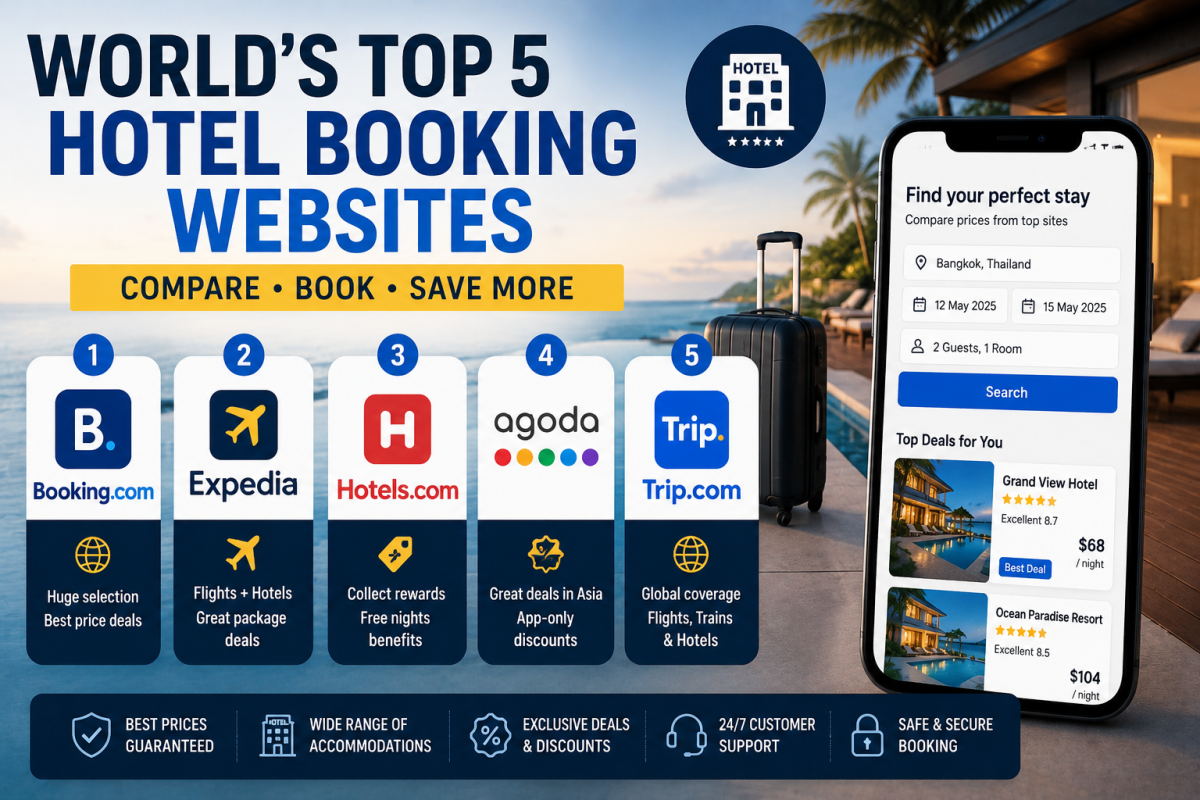
This guide compares five of the most popular hotel booking websites used by global travelers: Booking.com, Expedia, Hotels.com, Agoda and Trip.com. They are not identical. Booking.com is usually the broadest all-round hotel search option. Expedia is powerful for hotel-plus-flight packages. Hotels.com is convenient for simple hotel comparison and One Key rewards users. Agoda is especially strong in Asia and often aggressive with app pricing. Trip.com is useful for travelers who want hotels, flights, trains and regional travel services in one place, particularly across Asia and cross-border trips.
The purpose of this article is not to say one website is perfect. None is. A hotel booking site can show a good deal today and an average deal tomorrow. A platform can be excellent in Bangkok but less competitive in a small town in Europe. The best traveler checks the final price, reads the cancellation policy line by line, compares the room type carefully, and uses the booking site that fits the trip rather than the one with the loudest discount label.

Quick Ranking: Top 5 Popular Hotel Booking Websites
The table below gives a practical snapshot. Popularity can be measured in different ways: brand awareness, global supply, booked room nights, app usage, market presence, loyalty ecosystem, and regional strength. For most international travelers, these five names appear again and again because they cover a large share of real hotel-search behavior.
| Website | Best For | Main Strength | Watch Before Booking |
|---|---|---|---|
| Booking.com | All-round hotel search, city stays, apartments, resorts and international travel | Huge global accommodation selection, strong filters, reviews, Genius discounts and flexible booking options | Check whether taxes and fees are included, and confirm if free cancellation really applies to your selected room |
| Expedia | Hotel packages, flight-plus-hotel bundles, car rentals and one-account trip planning | Strong package booking ecosystem, One Key rewards, flights, cars, activities and hotels in one platform | Package deals can be good, but compare the same hotel separately before assuming the bundle is cheaper |
| Hotels.com | Simple hotel browsing, loyalty users, family trips and travelers who prefer a hotel-first site | Clear hotel-focused search, rewards through the Expedia Group One Key ecosystem and a familiar booking flow | Always compare with Expedia and the hotel direct website because inventory and promo rules can differ |
| Agoda | Asia travel, city hotels, budget stays, app deals and competitive prepaid hotel rates | Strong Asian inventory, frequent app-only pricing, filters for breakfast, free cancellation and pay-at-hotel options | Some rates are prepaid or non-refundable, so confirm currency, tax and cancellation before paying |
| Trip.com | Asia-focused travel, hotels, flights, trains, airport transfers and multi-service trip planning | Useful for travelers who want accommodation, transport and regional travel services together | Check customer support terms, cancellation rules and whether the hotel booking is direct or supplier-based |
How Hotel Booking Websites Actually Work
Most travelers think a hotel booking website simply lists hotels and sells rooms. The reality is more layered. Some websites work as online travel agencies. They receive inventory from hotels, chains, property managers, bed banks and distribution systems. Some rates are paid at the hotel. Some are prepaid. Some are refundable until a certain date. Others are cheaper because the traveler takes the risk of no refund. The same room may appear under different names: “deluxe king,” “superior double,” “standard room,” “city view king,” or “room assigned at check-in.” These names are not always standardized across platforms.
That is why comparing hotel sites is not only about price. You must compare the same dates, same number of guests, same room type, same meal plan, same cancellation rule, same taxes, and same payment timing. A $92 rate on one site may become $118 at checkout after taxes and fees. A $105 rate on another site may include breakfast, free cancellation and pay-later flexibility. The cheaper-looking option is not always cheaper in practice.
Professional travelers often use a simple process: search on two or three booking sites, check Google Maps for location, read recent reviews, open the hotel’s own website, compare the final price, then book through the channel that gives the best balance of value and protection. That process takes ten extra minutes. It can save money, stress and bad surprises at check-in.

1. Booking.com: Best All-Round Hotel Booking Website
Official website: Booking.com
Booking.com is probably the first hotel booking website many international travelers check. Its strength is breadth. The platform lists hotels, apartments, resorts, hostels, villas, guesthouses and alternative stays in a large number of destinations. For a traveler planning Paris, Dubai, Bangkok, Istanbul, Tokyo, London, Rome, New York, Bali or a small coastal town, Booking.com is often a good starting point because it usually has enough inventory to compare price levels, neighborhoods and guest ratings.
The best part of Booking.com is not just the number of properties. It is the search experience. Filters are practical. You can narrow results by budget, review score, distance from city center, breakfast, free cancellation, property type, facilities, room features and payment options. For families, filters like family rooms, kitchen, parking or washing machine can matter more than a small discount. For business travelers, location, workspace, Wi-Fi and breakfast timing may be the deciding factors. Booking.com makes those comparisons relatively quick.
The Genius loyalty program can also be useful. Some properties show extra discounts or perks for signed-in users. However, travelers should not assume a Genius rate is always the lowest possible price. Sometimes a hotel direct rate, mobile rate, Agoda rate or Expedia package can still beat it. Treat loyalty benefits as one part of the calculation, not the whole answer.
Booking.com is particularly good for travelers who want flexibility. Many listings offer free cancellation or pay-at-property options. That matters when flights are not confirmed, visa approval is pending, or weather may change the plan. For example, someone visiting Istanbul in winter may prefer a refundable hotel because flight delays and schedule changes are more likely. A honeymoon traveler going to Maldives may book a refundable city hotel in Male for the arrival night before confirming a resort transfer. In both cases, flexibility has real value.
The biggest caution is the final-price check. Some countries display taxes differently. Resort fees, city taxes, service charges and cleaning fees can change the final total. Also, “free cancellation” usually has a deadline. After that date, a fee may apply. Always click the room conditions before booking. Screenshot or save the booking terms, especially for expensive stays.
Best Booking.com Use Cases
- First search for almost any destination.
- Comparing many hotels in one city quickly.
- Flexible bookings with free cancellation or pay-later options.
- Apartment-style stays and guesthouses, not only classic hotels.
- Travelers who rely heavily on guest reviews and map filters.
2. Expedia: Best for Hotel + Flight Packages
Official website: Expedia
Expedia is more than a hotel site. It is a full online travel agency. The platform combines hotels, flights, car rentals, vacation packages, cruises and activities. That makes it especially useful when a traveler wants to book several parts of a trip together. A family going to Orlando may book flights, hotel and rental car in one flow. A couple planning Hawaii may find that a package gives a better total price than booking each part separately. A business traveler may prefer one account for hotel, flight and receipt management.
The advantage of Expedia is the package ecosystem. Hotels sometimes discount rooms when bundled with flights because the discount is less visible than a public standalone hotel rate. That can create real savings. But it is not guaranteed. The smart method is to compare three numbers: hotel alone, flight alone, and package total. Then check the same hotel on Booking.com, Hotels.com, Agoda or the hotel website. If the Expedia package is still cheaper and the cancellation terms are acceptable, it may be the best option.
Expedia also uses the One Key rewards ecosystem across Expedia, Hotels.com and Vrbo in supported markets. For travelers who already use one of those platforms, the rewards connection can be useful. A person booking multiple trips per year may prefer to keep bookings within one ecosystem for easier tracking. Occasional travelers should still compare prices because loyalty points do not help if the base price is much higher.
Expedia is also good for destinations where transport and hotel need to be planned together. Think Las Vegas, New York, Dubai, Singapore, London, Tokyo, Bangkok or European city breaks. A traveler can compare flights, airport transport, hotel neighborhoods and activities from one account. That convenience saves time, especially for people who do not enjoy opening ten tabs and building a trip manually.
The caution is complexity. Package bookings may have separate rules for the hotel and flight. A flight may be non-refundable while the hotel has a different cancellation deadline. If you need flexibility, read all terms carefully. Do not book a cheap package during an uncertain visa situation unless you understand the refund rules.
Best Expedia Use Cases
- Flight-plus-hotel packages.
- Travelers who want one account for hotels, flights, cars and activities.
- Family vacations where total trip cost matters more than hotel-only price.
- One Key rewards users.
- Travelers booking popular city or resort destinations with many package options.

3. Hotels.com: Best Simple Hotel-First Booking Site
Official website: Hotels.com
Hotels.com is owned by Expedia Group, but travelers still treat it as a separate hotel-first booking website. The interface is familiar, simple and focused on accommodation. For people who do not want the full package-booking experience of Expedia, Hotels.com can feel cleaner. Search a city, choose dates, filter by rating and price, read reviews, compare rooms, and book.
The main reason to use Hotels.com is simplicity. Some travelers do not want to compare flights, cars or activities inside the same booking flow. They just want a hotel, ideally with a clear cancellation rule and easy account history. Hotels.com works well for that. It is especially useful for city hotels, family stays, weekend trips and business travel where the hotel is the main purchase.
Since Hotels.com participates in the broader Expedia Group ecosystem, travelers may see rewards and account benefits connected with Expedia’s One Key program depending on region and eligibility. This is helpful if you already book through Expedia or Vrbo. But again, rewards should not replace price comparison. Before booking on Hotels.com, check the same stay on Expedia, Booking.com, the hotel direct site and perhaps Agoda or Trip.com if traveling in Asia.
Hotels.com may also be useful when looking for chain hotels. Many chain properties appear clearly, with recognizable room categories and review scores. However, chain hotels sometimes give member-only direct rates, late checkout, free Wi-Fi or loyalty-night benefits only when booking direct. If you are loyal to Marriott, Hilton, Hyatt, IHG or Accor, compare direct booking benefits before using any third-party platform.
The practical caution is to verify whether the booking is refundable, whether the hotel collects local taxes at check-in, and whether breakfast is included. A traveler may choose a slightly higher Hotels.com rate if it includes breakfast and free cancellation. Another traveler may choose the hotel direct rate if it includes loyalty benefits. The correct answer depends on the trip.
Best Hotels.com Use Cases
- Hotel-only bookings without too many extra travel products.
- Travelers who already use Expedia Group accounts or One Key rewards.
- Family and city hotel comparison.
- Simple booking flow for people who want less clutter.
- Comparing familiar chain hotels and independent properties.
4. Agoda: Best for Asia Hotel Deals and App Pricing
Official website: Agoda
Agoda is one of the strongest hotel booking websites for Asia. If you are traveling to Thailand, Malaysia, Indonesia, Vietnam, Philippines, Japan, South Korea, Singapore, India or the wider Asia-Pacific region, Agoda should almost always be part of your comparison. It is also owned by Booking Holdings, but its pricing behavior and regional inventory can differ from Booking.com. That difference can work in your favor.
Agoda is known for aggressive discounts, mobile app deals, coupon-style promotions and prepaid rates. In destinations like Bangkok, Kuala Lumpur, Bali, Phuket, Manila, Ho Chi Minh City or Tokyo, Agoda may show a lower price than other platforms for the same hotel. Sometimes the difference is small. Sometimes it is large enough to matter. Budget travelers, backpackers, digital nomads and frequent Asia travelers often keep Agoda in their search routine for this reason.
The best way to use Agoda is carefully. Open the hotel, select the same room type, and go to the final checkout page before comparing. Agoda sometimes displays taxes and fees later in the process depending on region and settings. Also check whether the deal is non-refundable. A cheaper prepaid room is fine when your trip is confirmed. It is risky if your visa, flight or work schedule may change.
Agoda can also be useful for hotels that offer pay-at-hotel options, breakfast filters, airport transfer information and guesthouse-style accommodation. Many small Asian hotels and local properties appear with detailed reviews and photos. For travelers who care about location, use the map carefully. A cheap hotel “near the beach” may still be a long walk in heat. A cheap hotel “near the city center” may be near the edge, not the area you actually want.
Customer support experiences with any large OTA can vary. If you book a complicated stay, arrive late at night, or travel during festival season, contact the hotel directly after booking and confirm your reservation. This is a good practice for all platforms, but it is especially useful when booking a small hotel, guesthouse or prepaid discount rate.
Best Agoda Use Cases
- Asia hotel bookings and city stays.
- App-only discounts and prepaid hotel deals.
- Budget travelers comparing many guesthouses and hotels.
- Travelers who can commit to non-refundable rates when the price is clearly better.
- Checking alternative prices against Booking.com for the same hotel.

5. Trip.com: Best for Asia Travel, Hotels, Flights and Regional Transport
Official website: Trip.com
Trip.com has grown into a major global travel platform, especially strong for travelers who move across Asia or want hotels, flights, trains and activities in the same account. It is particularly useful for China-related travel, East Asia routes, regional flights, train bookings where supported, airport transfers and accommodation. For travelers who need more than a hotel, Trip.com can be very practical.
The platform is useful because modern trips are rarely hotel-only. A traveler visiting Japan may need a hotel in Tokyo, a domestic flight or train connection, airport transport and possibly a local activity. Someone traveling to China, South Korea, Singapore, Thailand or Australia may prefer a platform that understands regional transport and hotel inventory better than a hotel-only site. Trip.com can serve that need.
For hotels, Trip.com often shows competitive prices, member deals, app discounts and package-style options. It is worth checking when Booking.com and Agoda prices look high, especially in Asian destinations. Like Agoda, Trip.com should be compared at the final checkout page. Taxes, payment method, cancellation rule and room type can change the real value of a rate.
Trip.com is also useful for travelers who want multi-service support. If the hotel, flight and train are all inside one travel app, itinerary management becomes easier. That does not automatically mean every component is cheapest. It means convenience is higher. For some travelers, that is worth it. For others, separate booking is better.
The caution is supplier complexity. Some hotel bookings may involve third-party supply chains. That can happen with many OTAs. If a trip is expensive, urgent or includes late-night arrival, confirm directly with the property after booking. Save your voucher offline. Keep the hotel phone number. And do not rely only on app access when traveling internationally; internet may fail exactly when you need the booking confirmation.
Best Trip.com Use Cases
- Asia-focused trips where hotels, flights and trains matter together.
- Travelers who want one app for multiple services.
- Checking prices against Agoda and Booking.com.
- Regional travel in China, East Asia and major Asia-Pacific destinations.
- Travelers who like app-based deals and itinerary management.
Which Hotel Booking Website Is Best for Different Travelers?
A solo backpacker, a family with children, a honeymoon couple and a business traveler do not need the same hotel website. The table below gives a practical recommendation based on real booking situations.
| Traveler Type | Best Website Shortlist | Why |
|---|---|---|
| First-time international traveler | Booking.com, Expedia | Easy search, lots of reviews, flexible options and broad destination coverage. |
| Family vacation planner | Expedia, Hotels.com, Booking.com | Family rooms, package savings, clear hotel comparison and rewards options. |
| Asia traveler | Agoda, Trip.com, Booking.com | Strong regional inventory, app deals and useful transport integration. |
| Business traveler | Booking.com, Expedia, Hotels.com | Good city hotel coverage, invoice-friendly booking history and reliable filters. |
| Budget traveler | Agoda, Booking.com, Trip.com | Frequent low rates, guesthouses, apartments, prepaid deals and mobile discounts. |
| Luxury or resort traveler | Booking.com, Expedia, hotel direct website | High-value bookings need careful room, transfer, cancellation and benefit comparison. |
How to Compare Hotel Prices Like a Professional
Hotel price comparison should be slow enough to be accurate. Start with your destination and dates on Booking.com. Note the top five hotels that fit your location and budget. Then open the same hotels on Agoda, Expedia or Trip.com. If you are in Asia, check Agoda and Trip.com early. If you are booking a flight too, check Expedia package pricing. If you prefer a hotel-only interface, check Hotels.com.
Then compare the final checkout price. Not the search result price. The checkout price. Look at taxes, city fees, resort fees, cleaning charges and service fees. Compare whether breakfast is included. Check whether payment is due now or at the property. Look at cancellation deadlines in local hotel time. Confirm the bed type and guest count. If traveling with children, check child policy. Some hotels charge extra for children above a certain age even if the room technically has space.
Finally, open the hotel direct website. Hotel chains sometimes offer member rates, free Wi-Fi, late checkout, points, room upgrades or flexible policies only for direct bookings. Independent hotels may match OTA prices if contacted directly, especially outside peak season. Do not demand a discount rudely. A simple message works: “I found your deluxe double room on an OTA for this date at this total price. Do you have a direct booking offer with free cancellation?” Sometimes they do. Sometimes they do not. Either way, you learn more.
Hotel Review Reading: What Actually Matters
Reviews are useful, but only when read carefully. Do not trust only the average rating. A hotel with 8.7 from 4,000 reviews is very different from a hotel with 9.5 from 12 reviews. Read the most recent reviews first. A hotel may have been excellent three years ago but now suffers from construction noise, poor maintenance or staff changes. Look for repeated patterns: dirty rooms, bad Wi-Fi, noisy nightclub nearby, unsafe street, broken air conditioning, elevator problems, rude check-in, surprise deposit, slow refunds.
Also read positive reviews critically. Some travelers give five stars because the room was cheap. Others give three stars because the hotel refused an unrealistic request. Focus on details that affect your trip. A digital nomad needs Wi-Fi and desk space. A parent needs cleanliness and safe location. A couple may care about atmosphere and view. A transit traveler needs airport distance, late check-in and early breakfast. A hotel can be excellent for one traveler and wrong for another.
Payment Safety and Refund Tips
Use a payment method that gives you records and some dispute protection. Credit cards are often safer than bank transfers for online travel purchases. Avoid paying outside the platform unless you are booking directly with the hotel through a trusted official channel. If a message says your booking will be cancelled unless you pay through a suspicious external link, be careful. Hotel booking scams exist, including fake payment links, impersonated hotel messages and phishing pages.
Save your booking confirmation as a PDF or screenshot. Keep the platform booking number and hotel confirmation number if available. For expensive stays, email the hotel after booking and ask them to confirm the reservation, room type and arrival time. If you need a visa support document, ask before the free cancellation deadline passes. If you are arriving after midnight, tell the hotel in advance. Many bad check-in experiences happen because the property thought the guest was a no-show.
Best Times to Book Hotels
There is no universal magic day for booking hotels. The best time depends on destination, season and event demand. For major cities with many hotels, you may find good rates 2 to 6 weeks before travel, especially outside peak periods. For beach resorts, festivals, conferences, school holidays and popular destinations, book earlier. A Tokyo cherry blossom trip, Paris Fashion Week stay, Makkah Ramadan booking, Maldives honeymoon resort or New York Christmas trip should not be left until the last moment.
If your plans are uncertain, book a refundable room early, then keep checking prices. If the rate drops, you may be able to cancel and rebook before the deadline. This strategy works only if you are organized. Put cancellation deadlines in your calendar. Do not forget them. A forgotten deadline can turn a flexible booking into an expensive mistake.
Final Verdict: Which One Should You Use?
If you want one hotel booking website to start with, use Booking.com. It is broad, practical and strong for many destinations. If you are booking a complete vacation with flights, use Expedia as a package comparison tool. If you want a simple hotel-first experience inside the Expedia Group ecosystem, check Hotels.com. If you are traveling in Asia or want aggressive app deals, never skip Agoda. If you want hotels plus regional transport and Asia-focused travel services, add Trip.com to your comparison list.
The smartest strategy is not loyalty to one website. It is a small routine: compare at least two platforms, check the hotel direct price, read recent reviews, confirm cancellation terms, and save all booking records. That habit protects your money better than any single discount badge. Good travel starts before the flight. It starts when you book the right room, at the right price, with the right conditions.