
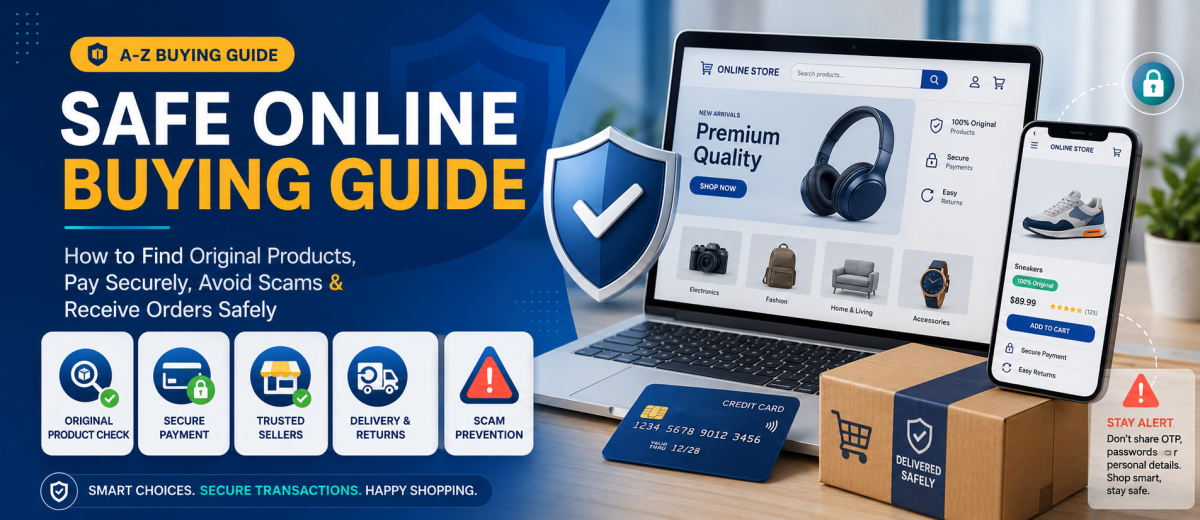
Buying online is no longer limited to clothes, phones or household products. Today people pay online for software, hotel bookings, airline tickets, freelance work, digital subscriptions, online courses, gaming items, second-hand goods, event tickets, food delivery, mobile top-ups, cross-border imports and even local peer-to-peer deals. The convenience is excellent, but the risk is also real. A fake store can look professional. A social media seller can use stolen photos. A marketplace listing can show an original product and deliver a copy. A buyer can pay through a method that gives no refund option. A seller can claim “limited stock” to create pressure. A digital service can disappear after receiving payment.
This guide is written for global readers who want a practical, realistic and human way to shop and transact online without becoming easy targets. It is not only about buying physical products. It covers any online transaction where money, personal information, delivery, trust or proof is involved. You will learn how to find original products, verify sellers, compare prices, choose safer payment methods, inspect products after delivery, avoid common scam signals and know what to do if something goes wrong. Before you buy from any unknown website or seller, slow down and research. The FTC online shopping guidance explains that credit cards often provide stronger protection and that HTTPS alone does not prove a website is legitimate. That one point is important: a lock icon means the connection is encrypted, not that the seller is honest.
1. The New Reality of Online Buying
Online buying has changed because the internet has changed. A customer may first see a product in a TikTok video, compare it on Google, read reviews on Reddit, check the brand website, find a coupon, pay through a mobile wallet and receive the item through a courier partner. That journey has many touchpoints. Every touchpoint can be useful, and every touchpoint can also be manipulated. Fake reviews, cloned stores, edited screenshots, fake tracking numbers, counterfeit certificates and urgent payment requests are now common in many markets.
The safest online buyer is not the person who never takes risk. The safest buyer is the person who knows which risks are normal and which risks are dangerous. A low price is not always a scam; clearance sales and coupons exist. A new seller is not always dishonest; every business starts somewhere. A delayed delivery is not always fraud; shipping networks fail sometimes. But when several warning signs appear together, you should pause. For example, a new seller with no verifiable business details, a price 70% cheaper than every other site, payment by bank transfer only, no return policy and pressure to pay within ten minutes is not a bargain. It is a trap.
2. Start with the Product: What Does “Original” Really Mean?
Original product means different things depending on the category. For a phone, original may mean factory sealed, official warranty, matching IMEI and genuine accessories. For a pair of sneakers, it may mean authentic stitching, correct box label, retail tags and a seller invoice. For software, it may mean a license from the official vendor or authorized reseller, not a cracked key or recycled account. For supplements, cosmetics and baby products, original means much more than branding; it also involves safety, expiry date, storage condition and regulatory compliance.
Before searching for a product, define what version you want. Write down the exact model, size, color, capacity, region, warranty type and included accessories. Many buyers get fooled because they search only by product name. A seller can list a “Pro Max style” case, “OEM-like” charger, “master copy” watch or “global version” device without providing the same quality as the official product. Read every word in the title and description. Scam and counterfeit listings often hide behind words like replica, inspired, compatible, renewed, refurbished, open box, seller warranty, imported version, no box, display unit, first copy or grade A. Some of these are legal and acceptable if clearly disclosed. The problem starts when the seller uses confusing language to make a non-original item look original.
3. Research the Normal Market Price Before You Trust a Deal
Price research is your first defense. Search the same product on the official brand store, major marketplaces, reputable retailers and local authorized sellers. Note the normal price range. Then compare the unknown seller’s offer with that range. A small discount is normal. A seasonal discount may be bigger. But if an expensive product is offered at an impossible price, you need a strong reason to believe it. Scammers rely on emotional buying. They want you to feel that you found a secret deal and must pay before someone else takes it.
When comparing prices, include shipping, customs, VAT, platform fees, currency conversion, return cost and warranty value. A product that is $20 cheaper but has no return option, no brand warranty and expensive shipping may actually be worse than buying from a slightly more expensive verified seller. For cross-border purchases, remember that import duty can turn a cheap deal into an expensive mistake. For digital products, remember that an unusually cheap lifetime subscription may violate the original service terms and may stop working later.
| Price Signal | What It Usually Means | Best Action |
|---|---|---|
| 5%–15% lower than trusted stores | Normal coupon, sale or marketplace competition | Check seller rating, return policy and payment protection |
| 25%–40% lower | Could be clearance, refurbished, imported or risky | Confirm condition, warranty, serial details and return terms |
| 50%+ lower on a high-demand product | High scam or counterfeit risk unless clearly explained | Avoid unless seller is highly trusted and payment is protected |
4. Choose the Right Buying Channel
The channel you use matters as much as the product. Buying from an official brand website gives the strongest authenticity confidence, but it may not always offer the lowest price. Buying from authorized retailers can balance authenticity, warranty and reasonable discounts. Buying from large marketplaces can be convenient because you may get buyer protection, public reviews and tracking. Buying from social media sellers can be cheaper or more local, but the risk is higher because identity and dispute systems are weaker. Peer-to-peer deals can be useful for used products, but you must inspect carefully and avoid irreversible payments.
For original products, official and authorized sources are usually the best options. For budget products, established marketplaces with buyer protection can be good. For rare or used products, specialist marketplaces, verified communities or local meetups may be better than random direct messages. For digital services, buy directly from the official provider or a known reseller. Avoid accounts sold through private messages, especially for streaming, design tools, software keys, cloud storage or gaming. Those accounts may be stolen, shared illegally or recovered by the original owner.
5. Verify the Website Before Entering Payment Details
A professional design does not prove legitimacy. Scammers can copy entire websites, logos, product photos and checkout pages. Before buying from a new website, inspect the domain carefully. Look for spelling tricks, extra hyphens, strange extensions and fake brand combinations. For example, a scam site may use a name that looks close to a famous brand but is not the official domain. Search the website name plus words like “reviews,” “scam,” “complaint,” “refund,” “fake,” and “trust.” Check whether the business has real contact information, clear terms, privacy policy, return policy and physical address. Then check whether those details make sense.
Do not rely on the lock icon alone. HTTPS protects the connection between your browser and the website, but scammers also use HTTPS. A fake shop can still have encryption. Look for deeper trust signals: consistent branding, working social profiles, real customer service, verifiable company registration, transparent shipping policy, normal grammar, realistic discounts and clear payment options. If the website was created recently, has no history, sells many luxury products at unbelievable discounts and only accepts risky payment methods, leave.
6. Verify Marketplace Sellers Like a Professional Buyer
Marketplaces are safer than random websites in many cases, but they are not risk-free. A marketplace listing can be created by the platform, an official store, a third-party seller or a dropshipper. Always check who is selling the product, who ships it and who handles returns. “Sold by brand” and “sold by marketplace” can be very different from “sold by unknown shop.” Read the seller profile, business age, ratings, number of completed orders and negative reviews. A seller with thousands of sales and a few complaints may be normal. A seller with only perfect five-star reviews that all sound similar may be suspicious.
Read reviews carefully. Do not only look at the star rating. Open one-star, two-star and three-star reviews first. Look for patterns: fake product, used item sold as new, wrong size, missing accessories, no warranty, poor packaging, seller refused return, tracking number fake. Then look at photo reviews. Real buyer photos usually reveal packaging, color, size and actual quality better than polished product images. For expensive items, message the seller before purchase. Ask a specific question. A genuine seller should answer clearly. A scammer often gives generic replies or pushes you to pay outside the platform.
7. Never Move a Marketplace Deal Outside the Platform
One of the biggest mistakes buyers make is leaving a protected platform to save a small amount. A seller may say, “Pay me directly and I will give you extra discount.” That sounds attractive, but it usually removes your buyer protection. If the seller disappears, the platform may not help because the transaction happened outside its system. Keep the conversation, payment and order inside the platform whenever possible. This is especially important for expensive goods, digital products, freelance services and cross-border orders.
Scammers want you outside the platform because outside payments are harder to dispute. They may ask for bank transfer, cryptocurrency, gift cards, mobile wallet personal transfer, friends-and-family payment or prepaid vouchers. These methods can be useful between trusted people, but they are dangerous for unknown sellers. The FTC mobile payment app advice warns that scammers use payment apps to steal money and that sending money to the wrong person can be difficult to reverse. Treat direct payments like cash. Once sent, you may not get it back.
8. Payment Safety: Which Method Is Best?
The best payment method depends on the type of transaction, but one rule is consistent: choose a method that gives you proof, dispute rights and a realistic refund path. Credit cards are often one of the safer options for online purchases because many card networks and issuers allow disputes for non-delivery, unauthorized charges or goods not as described. The FTC says paying by credit card can best protect you if a scam or purchase problem happens. Debit cards may also offer some protection, but the money leaves your account immediately, and rules differ by country and bank.
PayPal Goods and Services, marketplace checkout, escrow services and card payments can be safer than direct transfers when used correctly. Bank transfers, crypto, gift cards and “friends and family” wallet transfers are much riskier with unknown sellers. Cash on delivery can feel safe because you pay when the package arrives, but it is not perfect. Some couriers do not allow you to open and inspect before paying. You may receive a package containing the wrong item, a brick, a copy product or a damaged product. Cash on delivery is better when the platform has a return system and the courier allows inspection according to local rules.
| Payment Method | Protection Level | Use It When | Avoid It When |
|---|---|---|---|
| Credit card | High in many countries | Buying from websites, marketplaces or travel platforms | Website looks fake or redirects to suspicious checkout |
| Marketplace checkout | Medium to high | Platform has buyer protection and dispute system | Seller asks you to pay outside the platform |
| Mobile wallet personal transfer | Low to medium | Paying people you personally know | Unknown seller, urgent request, no invoice |
| Bank transfer | Low for unknown sellers | Trusted business with formal invoice | Social media seller or new website |
| Crypto or gift cards | Very low | Only when you fully understand the risk | Almost all normal shopping or service purchases |
9. How to Check Product Authenticity Before Buying
For branded products, begin with the brand’s official website. Find the official model number, images, packaging style, warranty rules and authorized seller list if available. Then compare the seller’s listing with those details. Ask for real photos, not only catalog images. For high-value items, request photos of the box label, serial number area, accessories, invoice and warranty card. Be careful with serial numbers: do not share your own serial numbers publicly, and remember that scammers can also copy serial numbers from genuine products. Use serial checks only as one part of your decision, not the only proof.
For electronics, check model region, plug type, warranty region, IMEI or serial format, charger authenticity, seal condition and return policy. For fashion, check stitching, logo placement, material texture, tag quality, box label, QR code behavior and seller source. For cosmetics and health-related products, check expiry date, batch code, packaging quality, seller storage practice and whether the seller is authorized. For digital products, confirm whether you receive a legal license under your own email, a transferable code, a subscription invite or shared account access. Shared accounts and “lifetime” accounts from unknown sellers are often unstable and may violate the provider’s terms.
10. Social Media Buying: Extra Care Required
Social media shops can be legitimate, especially small businesses that start on Instagram, Facebook, TikTok or WhatsApp. But social media is also a favorite place for scams because creating a page is easy. Check the page history. Was it created last week? Did it change names many times? Are comments disabled? Are all comments only emojis? Do the product photos appear on many other pages when you reverse search them? Does the seller provide a proper business address, return policy and customer support method?
Do not trust screenshots of bank transfers, fake customer reviews or edited courier receipts. These can be created in minutes. Ask for a small proof that is hard to fake, such as a short video showing the product with today’s date written on paper, or a live video call for expensive second-hand goods. Use platform messages instead of disappearing chats when possible. Keep all receipts, screenshots and seller details. If the seller becomes angry because you ask normal safety questions, that is useful information. A serious business may be busy, but it should not pressure or insult customers for asking about authenticity and return terms.
11. Buying Used or Second-Hand Products Online
Used products require a different mindset. You are not only checking authenticity; you are checking condition, ownership and hidden defects. For phones, laptops, cameras, watches, gaming consoles and bicycles, ask why the seller is selling, how long they used it, whether they have the original invoice, whether any repair was done and whether all functions work. For phones, check IMEI status, battery health, screen replacement signs, iCloud or Google lock, carrier lock and whether the device is stolen or blacklisted in your market. For laptops, check battery cycle count, SSD health, keyboard, ports, display, charger and overheating. For cameras, check shutter count, fungus, scratches and sensor condition.
For local second-hand purchases, meeting in a safe public place is better than paying full amount before inspection. For expensive items, meet inside a bank, shopping mall, courier office or police-supported safe exchange zone if available. Do not go alone to a private location with large cash. Do not accept stories like “send deposit first, many buyers are waiting.” A small refundable reservation through a protected platform may be okay, but direct deposits to unknown people are risky.
12. Digital Products, Online Services and Remote Work Transactions
Digital transactions are tricky because delivery can be instant, but proof can be weak. A seller may deliver a license key that works for one day and then gets blocked. A freelancer may ask for full payment before doing any work. A buyer may receive a file and then claim it was not delivered. A service provider may sell fake followers, copied templates, pirated software or accounts that break platform terms. For digital purchases, define the deliverable clearly before payment. What exactly will you receive? Under which email? Is it transferable? Is commercial use allowed? Are updates included? What happens if the license stops working?
For freelance work, use milestones. Do not pay 100% upfront to an unknown provider, and do not demand 100% work without paying anything. A fair structure protects both sides: small deposit, clear scope, first milestone, revision rules and final payment after delivery. Use reputable freelance platforms or escrow for larger projects. Keep communication in writing. For domain names, websites, social accounts and online businesses, use a specialized escrow service and verify ownership before release of funds. Never buy a social media account or ad account without understanding platform rules; many such transfers violate terms and can be recovered or banned.
13. Travel, Tickets and Booking Payments
Online transaction safety also applies to travel. Fake airline ticket agents, hotel booking scams, visa service scams and tour package frauds are common in many regions. Book through official airline websites, well-known travel platforms or licensed agencies. If you use an agent, verify their business registration, physical office, previous customers and official payment channel. After booking a flight, check the PNR directly on the airline website. After booking a hotel, contact the hotel to confirm the reservation. For tour packages, get the itinerary, inclusions, exclusions, cancellation policy and emergency contact in writing.
Do not pay for visas, immigration approvals or government fees through random social media pages. Use official government portals or recognized agencies. Be suspicious of anyone who promises guaranteed visas, guaranteed jobs abroad, or “special internal approval” for extra money. Scammers often exploit urgency and hope. A real travel business can explain the process, timeline, documents and refund conditions clearly.
14. The Checkout Page: Final Checks Before Payment
Before you click pay, review the order like an accountant. Check product name, variant, quantity, seller name, delivery address, phone number, email, shipping fee, tax, discount code, return window and final amount. Take a screenshot of the checkout page before payment. After payment, save the invoice, order number, transaction ID and confirmation email. If the seller later changes the listing, you still have proof of what you bought.
Make sure the payment page belongs to a legitimate payment provider or the correct website. Be careful if a checkout redirects to a strange domain, asks you to enter card details on an insecure page, or asks for OTP multiple times after failed payments. Never share your OTP, card PIN, full password or remote access to your device. A real seller does not need your OTP to “confirm” payment. A real bank employee does not need your password to reverse a transaction.
15. Delivery Safety: Tracking, Receiving and Unboxing
After purchase, track the package through the official courier website or app, not only the seller’s screenshot. Fake tracking numbers are common. If the tracking number does not work after a reasonable time, contact the seller through the platform. When the package arrives, inspect the outer packaging before accepting if your local delivery rules allow. Look for tampering, broken seals, wrong weight, damaged box or mismatched sender details.
For valuable products, record an unboxing video from the moment you receive the sealed package. Show the shipping label, package condition, opening process, product box, accessories and product condition in one continuous video. Do not pause and restart if possible. This can help in disputes when the seller claims you damaged the item or removed accessories. Keep the packaging until the return period ends. Many sellers require original packaging for returns.
16. How to Inspect a Product After Delivery
Do not throw away packaging immediately. First, compare the received product with the listing. Check model number, color, size, quantity, serial number, accessories and warranty documents. Test the product quickly within the return window. For electronics, record setup, check battery, screen, camera, speakers, charging, ports, Wi-Fi, Bluetooth and sensors. For appliances, inspect plug, voltage, manuals and physical damage. For clothing and shoes, check size, stitching, stains, smell, tags and material. For cosmetics or food-related products, check seal, expiry, smell, texture and batch code before use.
If something is wrong, do not delay. Contact the seller or platform immediately with clear evidence. Avoid emotional messages. Write the issue, attach photos or video, mention the order number and state your preferred solution: replacement, refund, missing part delivery or repair. If the seller offers a solution outside the platform, be careful. Keep the dispute inside the system whenever possible.
17. Return, Refund and Warranty Rules
Return policy is not a boring detail; it is part of the product value. Before buying, check how many days you have to return, who pays return shipping, whether opened items are accepted, whether restocking fees apply and whether sale items are final. Some products cannot be returned for hygiene or safety reasons. Some digital products cannot be refunded after activation. Some international orders require you to pay return shipping, which can cost more than the product.
Warranty also needs attention. Brand warranty, seller warranty, international warranty and no warranty are not the same. A seller warranty may depend entirely on that seller staying in business. A brand warranty may require purchase from authorized channels. An imported product may not be supported in your country. For expensive purchases, warranty clarity can be worth paying extra.
18. Common Scam Patterns You Should Recognize
Scams change, but many patterns repeat. Fake stores use copied product photos and unrealistic discounts. Non-delivery scams take payment and never ship. Counterfeit scams ship a low-quality copy instead of the original. Overpayment scams target sellers by sending fake payment emails. Refund scams ask buyers to share OTP or card details. Courier scams send fake delivery links that steal card information. Tech support scams claim your device or account has a problem and ask for remote access. Romance and investment scams may begin as conversation and slowly move toward money transfer.
The FBI common fraud guidance lists many fraud categories, including identity theft, non-delivery scams and payment card theft. The important lesson is that fraud is not limited to shopping sites. It can happen through email, messaging apps, calls, marketplace chats, fake invoices, job offers and investment pitches. Any time someone asks for money online, ask yourself: Do I know who this is? Can I verify the claim independently? Do I have a refund path? Is there pressure to act immediately?
| Red Flag | Why It Matters | What To Do |
|---|---|---|
| Seller demands urgent payment | Pressure reduces your ability to check details | Pause and compare with other sellers |
| Only accepts gift card, crypto or transfer | Refund and dispute options are weak | Use protected payment or avoid |
| No return policy or vague warranty | You may be stuck with a fake or broken item | Ask in writing or buy elsewhere |
| Seller asks for OTP or password | This can lead to account or money theft | Never share; contact your bank or platform |
19. Protect Your Accounts Before You Shop
Safe buying is not only about sellers. Your own accounts must be secure. Use strong unique passwords for email, banking, marketplace and payment accounts. Turn on two-factor authentication where available. Keep your phone number and recovery email updated. Do not save card details on unknown websites. Use virtual cards or spending limits if your bank supports them. Update your browser, phone and apps. Avoid shopping on public Wi-Fi unless you use a trusted secure connection. Do not install unknown shopping apps outside official app stores.
Your email account is especially important because it receives password resets, order confirmations and bank alerts. If a scammer controls your email, they can reset many other accounts. Use a unique password and two-factor authentication for email. Also be careful with browser extensions. Install only trusted extensions from official stores and review permissions. A malicious extension can read pages, inject ads or steal data.
20. International Buying and Cross-Border Transactions
Cross-border buying can offer better prices and unique products, but it adds customs, shipping, language, warranty and dispute complexity. Check whether the product is legal to import into your country. Some electronics, batteries, cosmetics, medicines, drones, knives, radio devices and food items may have restrictions. Check customs duty and VAT before ordering. Confirm whether the seller ships directly, uses a freight forwarder or requires you to arrange shipping.
For cross-border disputes, reporting options may be different. The econsumer.gov international complaint portal is designed for cross-border fraud complaints and is supported by consumer protection agencies from multiple countries. You should still contact your payment provider, marketplace and local consumer authority, but international reporting can help when the seller is outside your country.
21. What to Do If You Are Scammed
If you believe you were scammed, act quickly. First, stop communication if the scammer keeps asking for more money. Many victims lose more because scammers promise refund, customs release, account unlock or legal help for another fee. Second, collect evidence: order page, seller profile, messages, invoice, payment receipt, tracking number, emails, phone numbers, domain name and screenshots. Third, contact your payment provider immediately. Ask whether you can dispute the charge, reverse the transfer, freeze the card or block future payments.
Report the incident to the platform where it happened. If it involved a website, report the site to relevant consumer protection or cybercrime authorities in your country. In the United States, the FBI Internet Crime Complaint Center accepts reports for many cyber-enabled scams and fraud complaints. The CFPB fraud and scams resources also provide consumer information on recognizing and responding to financial scams. Even if you are outside the U.S., these resources are useful for learning the pattern and preparing your evidence.
22. Best Option by Transaction Type
There is no single best option for every online transaction. The best option depends on value, risk, seller trust and proof. For new branded products, buy from official brand stores, authorized retailers or major marketplaces with buyer protection. For expensive electronics, choose a seller with warranty, return policy and strong reviews, and pay by credit card or protected checkout. For used local products, inspect in person before paying and meet safely. For digital services, use milestone payments and written scope. For travel, confirm bookings directly with the airline or hotel. For subscriptions and software, buy through official websites or recognized resellers.
The worst option is usually the same across categories: unknown seller, urgent pressure, unrealistic price, direct irreversible payment and no written protection. Avoid that combination. Even if you miss one deal, you protect your money and identity.
23. A Practical Step-by-Step Safe Buying Checklist
- Define the exact product or service. Know the model, version, size, warranty and deliverable.
- Check normal market price. Compare official stores, trusted retailers and marketplaces.
- Verify seller identity. Look at history, reviews, address, contact details and policies.
- Read negative reviews. Search for repeated complaints about fake products or non-delivery.
- Use safer payment. Prefer credit card, platform checkout or escrow where appropriate.
- Keep everything in writing. Save screenshots, invoices, messages and tracking.
- Inspect delivery quickly. Record unboxing for valuable items and test before return window ends.
- Report problems fast. Contact seller, platform and payment provider without delay.
24. Final Advice: Buy Slowly, Pay Carefully, Keep Proof
Online buying is powerful when you use it with discipline. You can find better prices, rare products, global services and convenient delivery. But convenience should not make you careless. The safest buyers are not paranoid; they are systematic. They check the product, seller, payment method, delivery process and refund path before money leaves their account. They do not trust screenshots blindly. They do not share OTPs. They do not pay outside platforms to save a tiny amount on a risky deal. They keep proof until the transaction is fully complete.
Whenever you feel rushed, pause. Scammers hate patient buyers. A real seller can wait for you to read the policy, verify the details and choose a proper payment method. A real product can survive comparison. A real business can answer normal questions. If a deal only works when you stop thinking, it is probably not a deal worth taking.
Use this guide as your personal filter before any online transaction: Is the product real? Is the seller verifiable? Is the payment protected? Is delivery trackable? Is there a return or dispute path? Do I have proof? If the answer is yes, the transaction is much safer. If the answer is no, your best option is simple: do not pay yet.
25. How to Judge Reviews Without Getting Fooled
Reviews are useful, but modern reviews need careful reading. A five-star review is not automatically real, and a one-star review is not automatically fair. Start by checking whether the review explains actual product use. Real buyers often mention small details: delivery time, packaging, sizing, battery life, installation, smell, fit, noise, support response or the exact problem they faced. Fake reviews are often too general. They say “excellent product,” “best seller,” “fast delivery,” or “highly recommended” without explaining anything specific. Another sign of manipulation is timing. If many reviews were posted on the same day with similar language, the rating may be artificially boosted.
Photo and video reviews are usually better than text-only reviews, but they can also be reused from other listings. Use reverse image search when buying expensive items from unknown sellers. Read reviews from multiple places, not only the seller’s own website. Search the product name on independent forums, community posts, YouTube comments and trusted review sites. But remember that influencers can also be paid. The strongest signal is consistency across independent sources. If official details, marketplace reviews, community discussions and buyer photos all match, confidence increases. If every source tells a different story, slow down.
26. Safe Communication Rules With Sellers
Good communication can prevent many problems. Ask direct questions and keep the answers saved. Instead of asking “Is this original?” ask “Is this product covered by brand warranty in my country?” “Can you provide an invoice with your business name?” “Can I return it if the serial number does not match the listing?” “Who pays return shipping if the product is not as described?” Specific questions make it harder for a dishonest seller to hide behind general promises.
Do not accept vague answers like “Don’t worry, brother,” “100% trusted,” “many customers bought,” or “payment first then details.” Trust is not a replacement for terms. Also avoid emotional manipulation. Some scammers say they need urgent money, they are selling for hospital bills, they have many buyers waiting, or they can only hold the product if you pay now. These stories may sometimes be true, but your safety process should not disappear because of a story. A safe transaction needs proof, not pressure.
27. Special Risk Categories
Some categories need extra care because fake or unsafe products can harm health, privacy or finances. Medicines, supplements, baby products, cosmetics and food items should be bought from highly trusted sources because counterfeit or expired items can be dangerous. Smart home cameras, routers, storage devices and used phones can carry privacy risks if they are compromised or not reset properly. Luxury watches, designer bags, sneakers and branded fashion have high counterfeit risk. Event tickets and gift cards can be duplicated or drained before you use them. Crypto investments, trading signals, job placement fees and “guaranteed profit” services are not normal shopping; they are high-risk financial decisions and should be treated with extreme caution.
For any product that affects health, safety, legal status or financial security, do not make the decision based only on price. Choose official channels, verified providers and documented warranties. A cheap unsafe product is not a saving; it is a delayed cost.
28. Buyer Protection Is Useful, But It Has Limits
Buyer protection is not magic. It usually has deadlines, evidence requirements and exclusions. Some platforms protect non-delivery but not buyer’s remorse. Some protect physical products but not digital goods. Some require you to return the product with tracking before refund. Some deny claims if you paid outside the platform or confirmed receipt too early. Read the rules before relying on them. If a platform asks you to confirm that you received the product, do not click it until you actually receive and inspect the item.
When opening a dispute, provide organized evidence. Write a short timeline: order date, payment date, promised delivery date, actual delivery date, problem found, seller response and requested solution. Attach clear photos, video links if allowed, invoice and screenshots. Be factual. Platforms process many claims, so a clean case is stronger than a long angry message.
29. A Simple Decision Formula
Before paying, use this formula: Trust = Seller proof + Product proof + Payment protection + Delivery proof + Return path. If one part is weak, the other parts must be stronger. For example, if the seller is new, use a highly protected payment method and small first order. If the product is expensive, choose an established seller and written warranty. If the payment is irreversible, only use it with someone you already know and trust. If delivery is international, make sure tracking and customs terms are clear.
This formula works for products, services and digital deals. It turns a confusing decision into a simple risk check. The goal is not to remove all risk. The goal is to avoid stupid risk: paying unknown people in irreversible ways for unverifiable promises.
30. Conclusion
The internet gives buyers more choice than ever, but more choice also means more responsibility. A safe buyer compares prices, verifies sellers, understands payment protection, keeps proof and inspects delivery quickly. A safe buyer also knows when to walk away. No discount is worth losing money, identity, account access or peace of mind. Whether you are buying a phone, booking a hotel, hiring a freelancer, paying for software, ordering fashion, importing a gadget or sending money for a local service, the same rule applies: verify first, pay second, document everything.
If you remember only one line from this guide, remember this: online safety is not one big action; it is a series of small careful steps. Each step reduces risk. Together, they help you buy original products, make safer payments and avoid the scams that trap rushed buyers every day.