
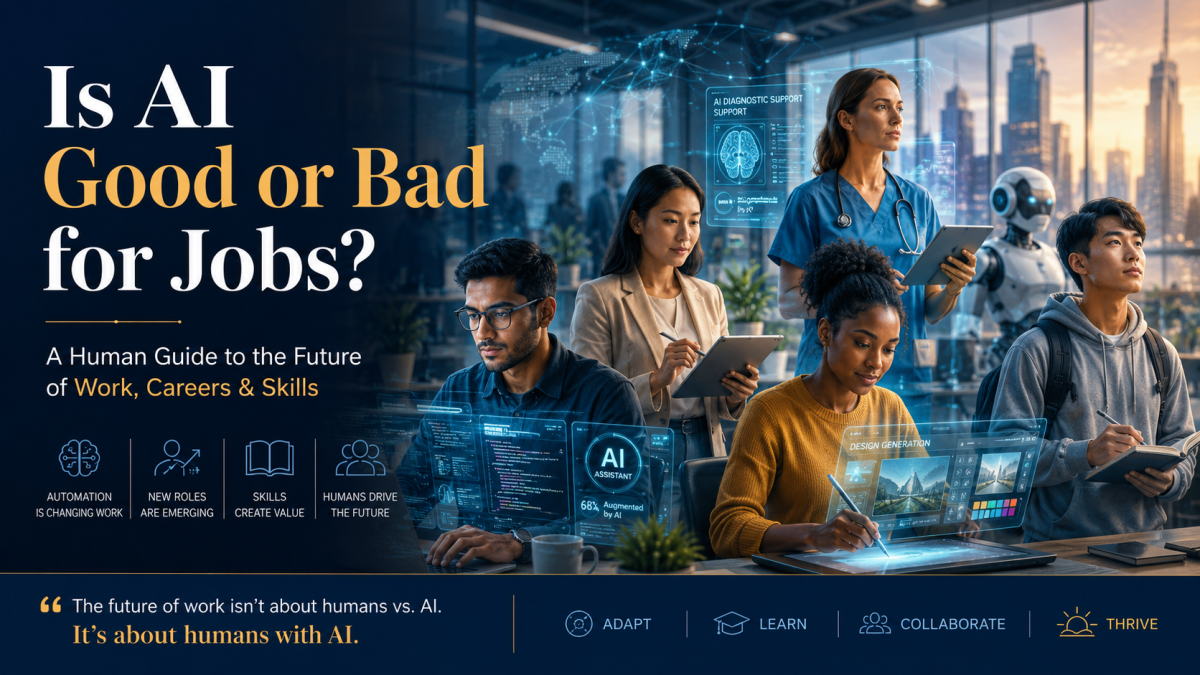
AI is no longer a distant technology story told from conference stages. It is already sitting inside email inboxes, design tools, customer service dashboards, code editors, search engines, accounting software, hiring systems and factory inspection lines. Some people use it quietly to write reports faster. Some companies use it openly to cut operating costs. A student asks it to explain a difficult chapter. A shop owner asks it to write product descriptions. A developer uses it to debug a stubborn error at midnight. A manager uses it to summarize a meeting she could not attend. That is the practical face of AI: not always a robot, not always a dramatic replacement, but a tool that keeps moving closer to daily work.
The job question, however, is much heavier. Is AI helping workers or hurting them? Will it create more opportunities, or will it make stable careers harder to find? The honest answer is not one clean sentence. AI appears to be doing both at the same time. It can make good workers faster, help small teams compete with larger companies, open new careers and reduce boring administrative work. It can also weaken entry-level jobs, reward people who already have skills, increase workplace monitoring, push wages down in some fields and allow companies to do more with fewer people. That tension is why the AI-and-jobs debate feels so personal. People are not only asking about technology. They are asking about rent, dignity, family pressure, career identity and whether the skills they spent years building will still matter.
This guide takes a careful, human look at that question. It avoids the easy fear that “AI will take every job” and the equally lazy optimism that “AI will only help everyone.” The reality is more uneven. A nurse, a graphic designer, a software developer, a customer support agent, a journalist, a bank analyst, a teacher, a factory technician and a small business owner will not experience AI in the same way. Some tasks will disappear. Some jobs will change. Some new roles will appear that sound strange today but normal five years from now. The people who understand that shift early may have a better chance of staying useful, confident and employable.

1. The Real Question Is Not “Will AI Take Jobs?”
The better question is: which parts of a job can AI do, which parts still need a person, and who controls the workflow? A job is rarely one task. A marketing assistant may research competitors, write captions, edit images, update spreadsheets, join client calls, track campaign results and handle last-minute changes from a manager. AI may help with several of those tasks, but it may not understand the client relationship, brand politics, legal risk or the quiet judgment that comes from experience. The danger begins when employers treat a partly automatable job as if it were fully replaceable.
Economists often talk about “tasks” instead of “jobs” for this reason. AI can automate, accelerate or reshape tasks. A full job disappears only when enough valuable tasks can be automated or when a company redesigns the role around fewer people. That distinction matters. It means AI may not replace an accountant tomorrow, but it could reduce the number of junior accountants needed for document sorting, invoice checking and basic reconciliation. It may not replace a teacher, but it could change how lesson plans, quizzes, feedback and tutoring are prepared. It may not replace a developer, but it could make one developer produce the output of two in certain code-heavy workflows.
Reports from major institutions point in the same direction: the effect will be large, but not simple. The World Economic Forum Future of Jobs Report 2025 projects major churn in the labor market by 2030, with many roles created and many displaced. The IMF has warned that AI may affect about 40% of jobs worldwide, replacing some tasks while complementing others. The International Labour Organization has also argued that generative AI is more likely to augment many jobs than fully automate them, though clerical and administrative roles may face strong pressure. Put simply: AI is not one wave hitting every worker equally. It is more like a flood entering different rooms at different speeds.
2. What AI Is Already Good At
AI is strongest when work involves language, patterns, prediction, classification, summarization or repeated digital steps. It can write first drafts, turn notes into structured documents, summarize long PDFs, generate code suggestions, translate text, create image concepts, analyze customer reviews, classify support tickets, produce spreadsheet formulas and help people search through large amounts of information. It is also improving quickly in voice, video, agents and multimodal systems that can interpret images, screenshots and documents together.
That does not mean AI understands the world the way a person does. It may produce confident mistakes. It may miss context. It may invent sources. It may fail when the task requires lived experience, ethical judgment, physical presence or accountability. Still, for many everyday office tasks, it can remove the first layer of effort. That is why adoption feels fast. Workers do not need a perfect machine to find value. They need a tool that saves fifteen minutes on an email, thirty minutes on a report, two hours on data cleanup or a full afternoon on a rough presentation.
Microsoft and LinkedIn’s work trend research has shown wide workplace interest in AI, while McKinsey’s State of AI research suggests that organizations are already using generative AI across functions such as marketing, sales, product development, service operations and software engineering. The story is not only about replacing people. It is also about raising the expected speed of work. Once a team knows a report can be drafted in ten minutes, the old timeline may start to look slow. That pressure can be helpful when it removes waste. It can become exhausting when it turns every worker into an always-on production machine.
| Work Area | How AI Helps | Main Risk | Human Skill Still Needed |
|---|---|---|---|
| Writing and content | Drafts, outlines, summaries, title ideas | Generic writing and weak facts | Voice, research, editing, taste |
| Software development | Code suggestions, debugging, tests, documentation | Security bugs and over-trust | Architecture, review, product thinking |
| Customer service | Chatbots, reply suggestions, ticket routing | Cold or wrong responses | Empathy, escalation, problem ownership |
| Design and media | Concepts, mockups, image editing, variations | Similarity, rights and low originality | Brand sense, composition, client taste |
| Administration | Scheduling, emails, notes, document sorting | Job compression | Coordination, trust, judgment |
3. The Good Side: AI Can Make Work Better
It is easy to focus only on fear, but AI can genuinely improve work when it is used with care. Many people spend too much of the day on tasks that are necessary but draining: formatting documents, rewriting the same type of email, searching through old files, preparing meeting notes, cleaning messy text or turning scattered ideas into a plan. AI can reduce that friction. A small business owner can respond to customers faster. A junior employee can ask AI to explain a technical term before a meeting. A freelancer can prepare a proposal structure without staring at a blank page for an hour.
AI can also lower barriers for people who previously needed expensive help. A person with limited English can draft a professional message and then edit it. A rural entrepreneur can create product photos, ads and basic website copy without hiring a full agency. A disabled worker may use voice tools, summarization and automation to reduce physical or cognitive strain. A teacher can generate practice questions for different levels of students. A doctor can use AI-assisted documentation to spend less time typing notes and more time with patients, though medical decisions must remain carefully supervised.
For countries and workers with fewer resources, the opportunity is real. AI can act like a learning partner, translation assistant, coding tutor, design helper and research organizer. It can give a motivated person access to explanations and examples that once required expensive training. This does not automatically create fairness. Internet access, language support, device quality and education still matter. But used well, AI could help millions of people move from basic digital use to more productive work.

4. The Bad Side: Some Jobs Will Become Harder to Keep
The uncomfortable part is that AI does not only assist workers. It can also make some workers easier to replace. When a company can use one experienced employee plus AI tools to produce the same output that previously required three junior employees, the hiring pipeline may shrink. Entry-level writers, basic graphic designers, data entry workers, transcriptionists, simple customer support agents, junior analysts and administrative assistants may feel pressure first because their early-career tasks often involve work that AI can imitate or speed up.
This is not because those people lack value. It is because the labor market often values output before potential. A beginner learns by doing simple tasks, making mistakes, receiving feedback and slowly building judgment. If AI absorbs many simple tasks, beginners may find it harder to get the first chance. That is one of the biggest risks for the future job market. We may not only lose jobs; we may damage the training ladder that turns beginners into professionals.
There is also a wage issue. If AI increases the supply of acceptable writing, design, coding or analysis, clients may expect lower prices for basic work. High-skill experts may earn more because they can use AI to multiply output. Mid-level workers who do not adapt may be squeezed. The labor market could become more unequal, with a smaller group of AI-capable professionals doing very well while others fight for cheaper, more standardized tasks. The IMF has raised similar concerns about AI and inequality, especially where workers lack access to training and social protection.
5. Which Jobs Are Most Exposed?
Exposure does not always mean replacement. A job is exposed when many of its tasks can be affected by AI. Some exposed jobs may become more productive rather than disappear. For example, lawyers, programmers and analysts are highly exposed because they work with language, logic and documents. Yet they also require judgment, accountability and domain expertise. A routine data-entry role may be less glamorous but more vulnerable if most of the work can be automated with fewer consequences.
Research from the OECD on AI and work suggests AI can bring productivity, job quality and safety benefits, but also risks such as automation, bias, privacy loss and reduced transparency. Pew Research Center has found that many workers feel worried, hopeful, overwhelmed and excited at the same time. That mixed feeling is sensible. People can see AI helping them today while still fearing what their employer may do with it tomorrow.
Jobs with heavy routine digital work are likely to change quickly. Jobs requiring physical presence, human care, complex trade skills, emotional intelligence or local accountability may change more slowly. A plumber, electrician, nurse, mechanic, chef, construction supervisor or childcare worker may use AI for scheduling, diagnostics, documentation or training, but the core physical and relational work remains difficult to automate fully. On the other hand, a remote role built mostly around producing text, sorting information or handling repetitive digital requests may feel AI pressure much faster.
| Higher Exposure | Why | Safer Direction |
|---|---|---|
| Basic content writing | AI can draft generic articles, captions and descriptions quickly | Research, editing, storytelling, niche expertise |
| Data entry and clerical work | Repetitive forms and document sorting are easy automation targets | Operations coordination, quality control, workflow management |
| Simple customer chat support | Chatbots can answer common questions at scale | Complex support, customer success, escalation handling |
| Junior coding tasks | AI can generate boilerplate, tests and basic fixes | System design, security, debugging, product ownership |
| Basic design assets | AI can create quick concepts and variations | Brand strategy, art direction, UX, client communication |
6. Which Jobs May Grow Because of AI?
AI will not only remove tasks. It will create demand for new skills around implementation, governance, safety, integration and human review. Companies need people who can choose AI tools, train staff, build internal workflows, secure data, evaluate outputs, design prompts, connect AI with existing systems and explain limitations to nontechnical teams. Many of these roles are not pure “AI scientist” jobs. They are hybrid jobs.
A marketing professional who understands AI content workflows may become more valuable. A developer who can build AI features safely into a Laravel, WordPress or mobile app may find new demand. A teacher who can use AI responsibly for lesson planning and student support may work more efficiently. A cybersecurity worker who understands prompt injection, model abuse and data leakage may become essential. A lawyer or compliance officer who understands AI governance may help companies avoid risky deployments. A product manager who can translate business problems into AI workflows may become more useful than someone who only follows old software planning habits.
New roles may include AI workflow designer, AI operations manager, AI safety analyst, prompt engineer, AI content editor, automation consultant, AI policy specialist, data quality manager, human-in-the-loop reviewer, AI trainer, synthetic data specialist and model evaluation lead. Some titles may fade, but the skills behind them will remain. The future job market may reward people who can stand between humans and machines and make the system actually work.
7. The New Career Rule: Be the Person Who Can Judge the Machine
Using AI is easy. Judging AI is harder. That may become one of the most valuable career skills. Anyone can ask a chatbot to write a sales email. Fewer people can tell whether the email is accurate, persuasive, legal, on-brand and appropriate for a specific customer. Anyone can ask AI to generate code. Fewer people can detect the security flaw, understand the architecture and know whether the code will fail under real traffic. Anyone can create an image. Fewer people can decide whether it fits the brand and does not mislead the audience.
This is where human expertise matters. AI raises the floor for basic output, but it also raises the value of taste, judgment and responsibility. A worker who only performs routine steps may be vulnerable. A worker who can define the problem, guide the tool, evaluate the result and explain the decision is harder to replace. The future belongs less to people who “know AI” in a shallow way and more to people who combine AI fluency with domain knowledge.
For example, a travel writer who uses AI to draft a Maldives itinerary still needs current visa rules, local transport knowledge, hotel context, realistic costs and personal editorial judgment. A cybersecurity writer using AI still needs to understand phishing, ransomware, MFA, secure backups and real user mistakes. A fashion blogger using AI still needs taste, fabric knowledge, sizing realities and market awareness. The tool can help. It cannot replace grounded experience.

8. What Students Should Learn Now
Students should not panic, but they should not ignore the shift either. The safest path is to build strong fundamentals and learn AI as an accelerator. If you study programming, learn algorithms, databases, security, debugging and system design — not only how to ask AI for code. If you study marketing, learn customer psychology, analytics, copywriting, branding and distribution — not only AI caption generation. If you study design, learn typography, layout, color, UX and client communication — not only image prompts.
AI can be a tutor, but it can also make students lazy if used badly. Copying AI answers may help pass an assignment, but it does not build skill. A better habit is to ask AI to explain concepts, quiz you, review your draft, compare two approaches or point out mistakes. Treat it like a study partner that sometimes lies. Verify. Rewrite. Practice without it. Then use it again to improve.
Students should also build a portfolio. In an AI-heavy job market, employers may care less about certificates alone and more about proof of ability. Build projects. Write case studies. Show before-and-after examples. Document how you solved problems. If you used AI, explain how you guided it and what human decisions you made. That honesty can make you look more mature, not less skilled.
9. What Workers Should Do If They Feel Threatened
If your job feels exposed to AI, the first step is not panic. The first step is mapping your work. Write down what you do each week. Separate tasks into four groups: tasks AI can already do well, tasks AI can help with, tasks AI cannot do reliably, and tasks that require trust, physical presence or personal judgment. This simple exercise shows where your risk is and where your advantage might be.
Next, learn the tool that threatens your task. That sounds uncomfortable, but it is practical. A content writer who refuses to test AI writing tools may not understand why clients change expectations. A customer support agent who learns chatbot limitations may become useful in training and supervising automated support. A designer who learns AI image workflows may move into art direction. A developer who learns AI coding tools may become better at review and architecture. You do not need to love the tool. You need to understand it well enough to stay ahead.
Then move closer to judgment, relationship and accountability. If AI can write the first draft, become the person who edits, verifies and improves it. If AI can answer basic support questions, become the person who handles angry customers, unusual cases and retention. If AI can generate code snippets, become the person who designs systems, tests security and understands user needs. The more your work depends on context and trust, the harder it is to replace with a generic model.
10. What Business Owners Should Understand
For business owners, AI can reduce cost and improve speed, but careless adoption can damage trust. A chatbot that gives wrong refund advice may create customer anger. An AI content system that publishes false information may hurt SEO and credibility. An AI hiring filter may reject good candidates unfairly. An employee pasting customer data into public tools may create privacy risk. The tool may look cheap until the cleanup begins.
A sensible company should start with clear use cases. Where are employees wasting time? Which tasks are repetitive but low-risk? Which workflows need human approval? Which data should never be pasted into AI tools? Who reviews outputs? How will mistakes be reported? These questions may sound boring, but they prevent expensive confusion. The NIST AI Risk Management Framework is useful for organizations that want a structured way to think about AI risk, governance, measurement and trustworthiness.
The best companies will not simply replace people with AI. They will redesign work so people use AI safely and productively. That means training workers, creating approved tool lists, protecting sensitive data, measuring quality and giving employees a voice. Workers often know where the real friction is. Ignoring them leads to shadow AI: employees using random tools secretly because official systems are too slow or too restrictive.
| Business Decision | Smart Approach | Mistake to Avoid |
|---|---|---|
| Customer support AI | Use AI for common questions and keep human escalation | Letting bots handle angry or complex cases alone |
| AI content | Use AI for drafts, then fact-check and edit manually | Publishing generic articles at scale with no review |
| AI hiring tools | Audit bias and keep human oversight | Rejecting candidates based only on automated scores |
| Internal AI tools | Create approved tools and data rules | Allowing uncontrolled shadow AI use |
| Automation | Start with low-risk tasks and review logs | Giving AI agents too much permission too early |
11. Will AI Make Unemployment Worse?
It might in some sectors and regions, especially during transitions. If companies adopt AI faster than workers can retrain, unemployment or underemployment could rise for exposed roles. But history suggests technology does not only destroy jobs; it changes the structure of work. The problem is timing. New opportunities do not always appear in the same place, for the same people, with the same wages. A displaced administrative worker cannot instantly become an AI systems engineer. A junior designer cannot immediately become a brand strategist without practice, clients and mentorship.
The World Economic Forum’s projection of large job creation alongside displacement captures that uncomfortable truth. Net growth can exist while millions of individuals still suffer disruption. A country may gain jobs overall, but a specific worker may lose income. A company may become more efficient, but a young graduate may struggle to get an entry-level role. This is why policy matters: training programs, unemployment support, worker protections, education reform and access to affordable digital tools can shape whether AI becomes a productivity boom or a social shock.
For developing economies, the picture is mixed. AI can help workers access global markets, learn skills and build businesses faster. At the same time, it may reduce demand for outsourced routine digital tasks such as basic data entry, simple content writing and low-complexity support. Countries that invest in digital education, English/local-language AI tools, internet infrastructure and small business training may benefit more. Countries that rely heavily on low-cost routine digital labor may face pressure unless they move up the value chain.
12. The Future of AI: Agents, Multimodal Tools and Personal Assistants
The next stage of AI will likely feel less like a chatbot and more like a set of digital workers inside software. AI agents may book meetings, update websites, analyze sales data, write code, search internal documents, prepare invoices, create reports and trigger actions across apps. Multimodal AI will read screenshots, documents, audio, images and video together. Voice-based AI assistants may become common for customer service, tutoring, sales and personal productivity.
This future could be very useful. Imagine a small business owner asking an AI agent to check inventory, draft a supplier email, prepare a social post and update a weekly sales dashboard. Imagine a student asking an AI tutor to explain math through voice and examples. Imagine a doctor using AI to summarize patient history before entering the room. Imagine a developer asking an assistant to scan a codebase and suggest where a bug begins. These workflows can save time and reduce friction.
But agents also raise the stakes. A chatbot that gives a bad answer is one risk. An agent that takes the wrong action is another. If AI can send emails, delete files, change prices, approve refunds, deploy code or move money, governance becomes essential. The future of AI will not only be about model intelligence. It will be about permission, auditing, accountability and human control.

13. Skills That May Protect Your Career
No skill is perfectly future-proof, but some skills age better than others. The safest workers are not always the ones who know the newest tool. Tools change. The safer workers understand problems deeply and can adapt when tools change. They communicate clearly, learn quickly, manage uncertainty and make responsible decisions.
AI literacy is now part of basic digital literacy. Workers should know what AI can do, where it fails, how to write clear prompts, how to verify outputs and how to protect sensitive data. But AI literacy alone is not enough. Add domain expertise. A finance worker should understand finance. A designer should understand design. A teacher should understand learning. A developer should understand software engineering. AI makes shallow knowledge easier to fake for a while, but real expertise still shows up when something breaks.
Other valuable skills include critical thinking, writing, data interpretation, cybersecurity awareness, project management, customer communication, ethical judgment, sales ability, emotional intelligence and systems thinking. Systems thinking matters because AI often changes workflows, not just individual tasks. The person who can redesign a process around AI may be more valuable than the person who only uses AI for small shortcuts.
| Skill | Why It Matters | How to Practice |
|---|---|---|
| AI literacy | Helps you use tools safely and effectively | Use AI for real tasks, then verify the result |
| Critical thinking | Prevents blind trust in AI output | Ask what evidence supports each claim |
| Domain expertise | Lets you judge quality better than a general tool | Study cases, build projects, learn fundamentals |
| Communication | Human trust still depends on clear explanation | Write summaries, present decisions, handle feedback |
| Workflow design | AI value comes from better systems, not random prompts | Map repetitive work and improve one step at a time |
14. The Human Qualities AI Cannot Easily Copy
People sometimes say AI cannot replace creativity, but that is too simple. AI can produce creative-looking material. It can write poems, generate logos, create music sketches and suggest campaign ideas. The deeper human advantage is not just creativity. It is lived context, intention, responsibility and taste. A person knows why a joke may hurt a community. A teacher notices a quiet student losing confidence. A founder understands the fear behind a customer complaint. A designer reads the room during a client presentation. A nurse senses when a patient is not telling the full story.
These human signals are not always visible in data. They come from experience, relationships and moral responsibility. AI can imitate empathy in language, but it does not carry consequences the way a person does. If an AI gives bad advice, a human or organization still has to answer for it. That accountability is why humans must remain central in high-stakes decisions.
The future may reward people who bring more humanity to technical work. A support manager who combines AI efficiency with genuine care may outperform a cheap chatbot. A writer who combines AI research assistance with real reporting may beat generic content farms. A developer who writes less boilerplate but thinks more deeply about users may become more valuable. AI may automate average output, but it can also make authentic human judgment easier to recognize.
15. AI and Inequality: The Part People Avoid
AI could widen inequality if access to tools, training and opportunity remains uneven. Workers in rich companies may receive paid AI tools, internal training and time to experiment. Workers in small firms may be told to “use AI” without guidance. Freelancers may face lower prices from clients who assume AI makes everything easy. Students with better devices and internet may learn faster. Workers in lower-income regions may compete against AI-generated output while lacking access to the same productivity tools.
There is also a language gap. English often receives the strongest AI support, while many local languages still get weaker outputs. That matters for education, customer service, legal information, healthcare guidance and small business content. If AI tools do not work equally well across languages and cultures, benefits will not spread evenly.
Workplace surveillance is another risk. AI can measure productivity, score calls, monitor messages, analyze facial expressions, rank candidates and predict worker behavior. Some uses may improve safety or efficiency. Others may become invasive. Workers need transparency. They should know when AI is used, what data is collected, how decisions are made and how they can appeal. Without rules, AI can quietly shift power from workers to employers.
16. Will AI Make Work More Meaningful?
It could. If AI removes repetitive paperwork, workers may spend more time on creative thinking, customer relationships, strategy, teaching, care and problem solving. That is the optimistic version. A doctor spends less time typing. A teacher spends less time formatting worksheets. A designer spends less time resizing assets. A business owner spends less time writing repetitive replies. Work becomes more human because the machine handles the dull parts.
But there is another version. AI removes the easy parts and leaves humans with only stressful edge cases, constant supervision and higher output targets. A support worker handles only angry customers because bots answer simple questions. A writer edits endless AI drafts instead of reporting original stories. A developer reviews machine-generated code all day. A manager tracks more dashboards but has less time for people. In that version, work becomes more intense, not more meaningful.
The difference depends on choices made by employers, governments, tool builders and workers. AI does not automatically improve job quality. It must be implemented with that goal in mind. Productivity should not mean squeezing more from tired people. It should mean removing waste, improving quality and giving workers better tools.
17. How to Prepare: A Practical 90-Day Plan
Preparation does not require a full career reset. A practical 90-day plan can help. In the first 30 days, learn basic AI tools. Use one chatbot, one AI search or research tool and one tool related to your field. Test them on real work, not random demos. Keep notes on where they help and where they fail.
In days 31 to 60, build one AI-assisted workflow. If you are a writer, create a research-outline-editing process. If you are a developer, create a code-review and documentation workflow. If you are a student, create a study plan and flashcard system. If you run a business, create a customer FAQ and reply-draft workflow. Keep human review in the loop.
In days 61 to 90, publish proof. Create a portfolio piece, case study, small project, article, video or internal presentation showing how you used AI responsibly to improve quality or save time. The goal is not to say “I use AI.” The goal is to show judgment: what you automated, what you checked, what you improved and what results you achieved.
18. A Balanced Verdict: Good or Bad for Jobs?
AI is good for jobs when it helps people do better work, learn faster, reduce boring tasks, build businesses and solve problems that were previously too expensive or slow. AI is bad for jobs when it is used mainly to cut people, weaken wages, remove entry-level opportunities, invade privacy or turn work into constant machine-supervised output. The technology itself does not decide which future we get. Institutions, companies and workers shape it.
For individuals, the safest attitude is active realism. Do not dismiss AI as hype. Do not worship it as magic. Learn it. Test it. Use it where it helps. Question it where it overreaches. Build skills that make you more than a task performer. The workers most at risk are often those who do not see the change coming or who wait for their employer to explain it. The workers with better chances are the ones who start experimenting early and move toward judgment, creativity, trust and problem ownership.
For businesses, the message is also clear. AI adoption should not be a secret cost-cutting race. It should be a serious redesign of work. Train employees. Protect data. Keep humans responsible for high-stakes decisions. Measure quality, not only speed. A company that uses AI to support skilled people may become stronger. A company that uses AI to replace knowledge without building governance may save money briefly and lose trust later.
19. Final Thoughts: The Future Still Needs People
The future job market will not be simple. Some people will lose work. Some will find better opportunities. Some roles will shrink, and others will be born. Many jobs will keep the same title but feel different inside. That is already happening. The old line between “technical” and “nontechnical” work is fading because almost every professional now needs some digital judgment.
Still, the future is not only about machines becoming smarter. It is about people deciding what kind of work culture they want. We can use AI to make education more personal, healthcare less burdened, small businesses more capable and knowledge more accessible. We can also use it badly, creating shallow content, unfair decisions, job insecurity and surveillance. Both paths are possible.
The best answer to AI is not fear. It is preparation. Learn the tools, but do not become dependent on them. Build human skills, but do not ignore technical change. Stay curious, but stay critical. The job market will reward people who can adapt without losing their judgment. AI may change the shape of work, but people will still decide what work is worth doing.
Quick Reader Takeaway
AI will not affect every career equally. Routine digital tasks are most exposed, while judgment-heavy, relationship-based and physical roles may be safer. The best personal strategy is to combine AI literacy with real domain expertise, communication, critical thinking and responsible decision-making.
20. How AI Changes Freelancing and Online Income
Freelancers may feel the AI shift sooner than traditional employees because freelance markets react quickly to price and speed. A client who once paid for ten short product descriptions may now expect a lower price because AI can create a rough draft. A designer may be asked to produce more concepts in less time. A video editor may face clients who think AI captions, cuts and thumbnails should reduce the project cost. This pressure is real, and ignoring it will not help.
But freelancing is not dead. It is becoming less forgiving of generic work. A freelancer who only sells basic output may struggle. A freelancer who sells strategy, taste, speed, reliable communication and final quality can still win. The service should move from “I will write your article” to “I will research, structure, fact-check, edit and publish a useful article that fits your audience.” It should move from “I will make a logo” to “I will create a brand direction that works across your website, social posts and packaging.” AI can make the production faster, but the offer must become more thoughtful.
Freelancers should also be transparent without over-explaining. Clients usually care about results, rights, originality and confidentiality. If AI is part of the workflow, the freelancer should still protect client data, verify facts and deliver polished human-reviewed work. A sloppy AI draft is not a professional service. A carefully directed, edited and improved AI-assisted workflow can be.
21. AI, Creativity and the Fear of Becoming Average
One quiet fear among writers, designers, musicians and creators is that AI will flood the internet with average work. That fear is reasonable. When tools make production cheap, the amount of content increases. More blog posts, more images, more videos, more captions, more templates. The internet becomes louder. In a loud market, average work becomes invisible faster.
The answer is not to reject AI completely. The answer is to become more specific. Specific taste beats generic output. A travel writer who has actually used local ferries, dealt with airport transfers and compared guesthouse islands writes differently from a tool summarizing search results. A fashion writer who understands fabric weight, climate, body shape and real wardrobe habits offers something AI cannot easily fake. A technology reviewer who tests battery life, setup friction and warranty support gives readers practical value.
AI can imitate style, but it struggles with genuine perspective. If creators want to survive, they need more perspective, not more filler. They should interview people, test products, use screenshots, show mistakes, collect data, compare real prices and write with a clear point of view. The future may punish lazy content, but it can reward useful content even more.
22. Why Entry-Level Jobs Need Protection
Entry-level work has always included boring tasks. That is not necessarily bad. A junior lawyer reviews documents to learn patterns. A junior developer fixes small bugs to understand a codebase. A junior marketer formats reports to understand campaign data. A junior journalist writes short updates before handling larger investigations. These tasks are training grounds.
If AI removes too many entry-level tasks without creating new training paths, industries may create a strange problem: they will need experts but fail to develop beginners. Companies may say they want experienced workers, while refusing to hire and train the people who could become experienced. That is not sustainable. Organizations should redesign junior roles instead of simply eliminating them.
A better junior role might include AI-assisted research plus human verification, data labeling plus analysis, draft generation plus editing, chatbot review plus customer escalation, code generation plus testing and documentation. Beginners can learn faster with AI, but they need mentorship. Without mentorship, they may become button-pushers who do not understand the work.
23. The Ethics Question: Who Benefits?
Every major workplace technology raises a basic question: who receives the benefits? If AI saves ten hours a week, does the worker gain time for better work and learning, or does the company simply increase the workload? If AI improves productivity, do wages rise, prices fall, jobs become safer and services improve? Or do only shareholders and executives benefit? These are not technical questions. They are social and economic choices.
Workers may reasonably ask for transparency when AI affects hiring, scheduling, evaluation, pay, promotion or discipline. They may also ask for training before being judged against AI-raised expectations. A company should not introduce automation, keep workers uninformed and then punish them for not adapting quickly enough. Trust requires fairness.
Consumers also have a stake. If AI-generated content fills websites with weak advice, readers lose. If AI support bots trap customers in loops, customers lose. If AI makes products cheaper and support faster while keeping human help available, customers benefit. The quality of implementation matters more than the label “AI-powered.”
24. Practical AI Safety Rules for Everyday Workers
Most workers do not need to become AI researchers, but they do need simple safety rules. First, do not paste sensitive information into tools you do not understand. That includes passwords, private customer data, unpublished financial numbers, legal documents, source code secrets, medical information and confidential business plans. Second, verify important outputs. AI can help prepare an answer, but it should not be the final authority for legal, medical, financial, security or safety decisions.
Third, keep records. If AI helps with a business decision, save the source material and note what was checked. Fourth, do not let AI write in your name without review. Your reputation belongs to you, not the tool. Fifth, learn your organization’s policy. If there is no policy, ask for one. Many workplace risks happen because employees want to be productive but do not know the boundary.
The FTC has warned businesses against exaggerated AI claims, and security communities such as OWASP track risks in AI applications, including data leakage and prompt injection. These resources are useful because they remind us that AI safety is not only about science fiction. It is about ordinary mistakes made in ordinary workplaces.
25. What a Human-Friendly AI Future Could Look Like
A human-friendly AI future would not mean fewer people matter. It would mean people spend less time fighting software and more time solving meaningful problems. Teachers would get help with preparation but keep the relationship with students. Doctors would get documentation support but keep clinical judgment. Small businesses would automate routine replies but still care about customers. Developers would generate boilerplate faster but still design secure systems. Writers would research and structure faster but still report, edit and think.
In that future, AI becomes infrastructure: powerful, normal and mostly invisible. People do not brag that they used electricity to write a report. They will eventually stop bragging that they used AI. The question will become quality. Did the work help someone? Was it accurate? Was it fair? Was it safe? Did it respect the reader, customer, patient, student or worker?
The opposite future is also possible: cheap content, weak accountability, job insecurity, privacy loss and machine-driven pressure. Avoiding that future requires more than individual skill. It requires better rules, better education, responsible companies and workers who understand their rights. AI will shape work, but it should not be allowed to quietly decide the value of human beings.