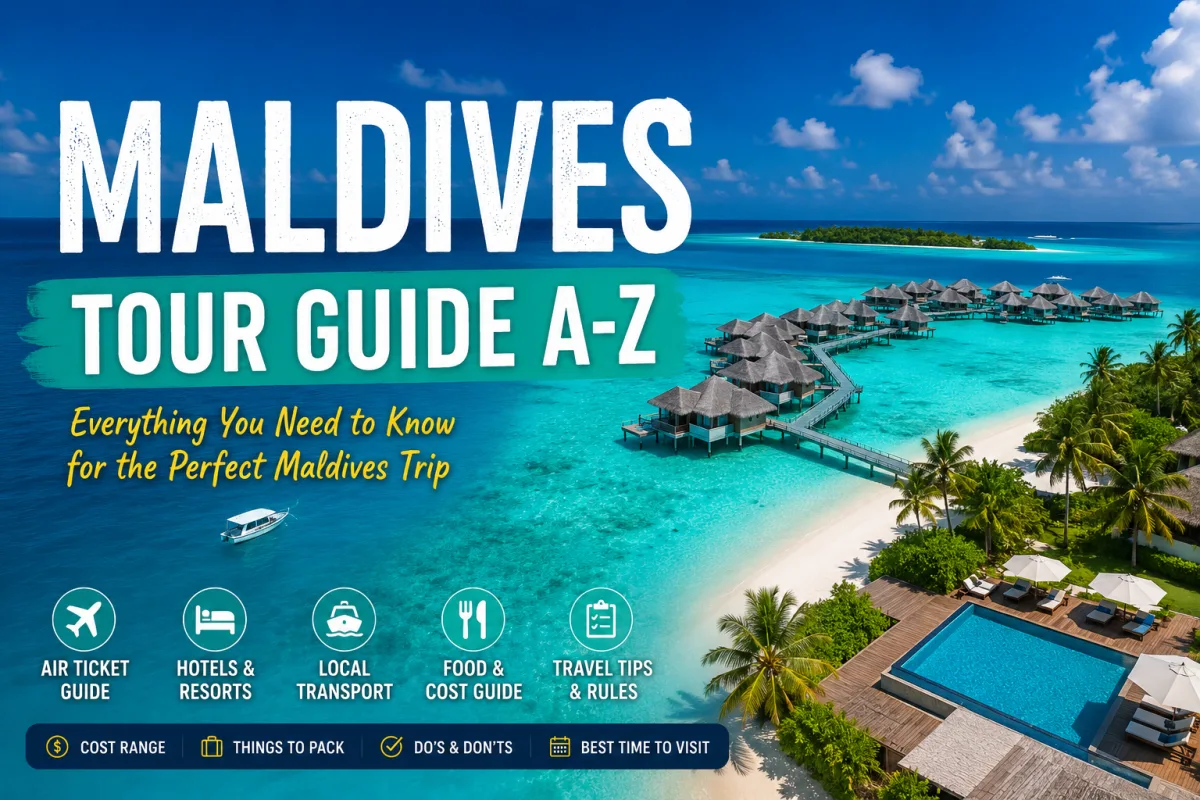
Maldives looks simple from a distance: blue water, white sand, overwater villas and calm sunsets. But once you start planning the trip, you quickly realise that Maldives is not one single island where you can land, take a taxi and choose any beach. It is a chain of almost 1,200 coral islands spread across the Indian Ocean, and every decision affects your total cost: which airport you fly into, which island you choose, whether your hotel is on a private resort island or a local island, whether you need a speedboat, domestic flight or seaplane, and whether your package includes meals, taxes and transfers.
This A-Z Maldives tour guide is written for global travellers: honeymoon couples, families, solo travellers, digital workers, budget backpackers and luxury holidaymakers. The goal is not to sell one fixed package. The goal is to help you understand how Maldives actually works so you can choose the right island, right transport, right hotel, right food plan and right budget before you book.
Important rules and entry information can change, so before travelling always check official sources such as the Maldives Immigration Traveller Declaration portal, the official Visit Maldives website, your airline, your hotel and your own government travel advisory. This guide explains the practical side in plain English and gives you a realistic planning framework.
Quick Maldives Trip Summary
If you want the shortest possible answer, Maldives has three main travel styles. A private resort stay is the easiest and most polished option. Your resort arranges the transfer, food is usually available on site, alcohol is available in licensed resort areas, and the whole trip feels private. The downside is price: rooms, transfers, drinks and activities can become expensive very fast.
A local island stay is the value option. You stay in a guesthouse or small hotel on an inhabited island such as Maafushi, Thulusdhoo, Dhigurah, Fulidhoo, Ukulhas or Rasdhoo. You get better room prices, cheaper cafés, local culture, public or shared speedboat options, and affordable excursions. The trade-off is that local-island rules are more conservative: alcohol is not available, swimwear is restricted to designated tourist beach areas, and you need to dress modestly in villages.
A mixed trip is often the smartest. For example, spend three nights on a local island to enjoy excursions and reduce cost, then finish with two nights on a resort island for the classic overwater-villa experience. Many travellers get the best memories and best value from this combination.
| Trip Style | Best For | Main Benefits | Main Drawbacks | Approx. Daily Budget |
|---|---|---|---|---|
| Local Island | Budget travellers, backpackers, culture lovers | Lower hotel cost, cheaper food, local cafés, affordable tours | No alcohol, modest dress rules, limited nightlife | US$60–180 per person |
| Private Resort | Honeymooners, families, luxury travellers | Privacy, polished service, resort beaches, alcohol, easy planning | High transfer, food, drinks and activity costs | US$250–1,500+ per person |
| Mixed Local + Resort | Value-focused couples and first-timers | Balanced cost, culture plus luxury, flexible itinerary | More transfer planning, more packing/unpacking | US$130–600+ per person |
Detailed Pre-Booking Checklist
Before you pay for flights or accommodation, open a simple note on your phone and write down your full route from home airport to your final island. Include international flight arrival time, immigration time, baggage collection, airport meeting point, boat or flight transfer, check-in time and return transfer. This small exercise reveals problems early. For example, a resort may look perfect until you realise your flight lands at 7:00 p.m. and the seaplane desk cannot send you to the island until the next morning. A local island may look cheap until you realise the public ferry does not run on your arrival day. Maldives rewards travellers who check logistics before emotion.
For hotels, read the cancellation policy carefully. Some resort bookings are prepaid and non-refundable during peak season. Some guesthouses are flexible but may charge separately for speedboat seats. Ask the property to confirm the final amount including taxes, green tax, service charge, transfer, meal plan and child policies. A clear written confirmation can save arguments at check-in.
How to Save Money Without Spoiling the Trip
Travel in shoulder season, compare nearby islands, avoid unnecessary seaplane transfers, book meal plans wisely and do not change islands too often. If your budget is limited, spend on experiences rather than the most expensive room category. A clean guesthouse plus two excellent snorkelling trips may create better memories than a beautiful resort room where every activity is too expensive to book. On the other hand, if the main dream is an overwater villa, reduce the number of nights in that room and combine it with a cheaper beach villa or local island stay.
Water, coffee, soft drinks and snacks can be expensive on resorts. All-inclusive can be good value for travellers who drink, snack and stay on the island all day. But if you are mostly out diving or joining excursions, half-board may be enough. Local islands offer the easiest food savings because you can eat at cafés, buy snacks from small shops and choose tours competitively.
Airport Arrival: What Happens After Landing?
After landing at MLE, you pass immigration, collect luggage and exit into the arrivals area. Resort guests usually find a resort representative holding a sign or waiting at a counter. The representative guides you to the speedboat jetty, domestic terminal or seaplane terminal. Local island guests may meet a guesthouse representative or follow instructions to a shared speedboat meeting point. Keep your phone charged and keep WhatsApp active because many hotels use it for transfer coordination.
Do not plan a tight same-day self-transfer unless you understand the schedule. Island transport is not like ordering a ride-share car. Weather, sea conditions and flight delays matter. Build patience into your first day. Many smooth Maldives trips begin with a simple decision: choose an arrival time that matches the island transfer.
Environmental Responsibility
Use reef-safe sunscreen where possible, never stand on coral, do not take shells or coral pieces, refuse single-use plastic when you can, and choose operators who respect wildlife. The Maldives depends on healthy reefs. A careless fin kick can damage coral that took years to grow. If you are new to snorkelling, practise floating calmly before entering shallow reef areas. Watch marine life without chasing it. The best underwater encounters happen when you move slowly and let the ocean come to you.
Who Should Not Choose Maldives?
Maldives may not be the best destination if you want big-city nightlife, long road trips, shopping streets, mountain hiking or cheap alcohol. It is also not ideal for travellers who dislike boats, strict luggage rules or fixed island logistics. If you need constant movement and many land attractions, you may prefer Thailand, Indonesia, Sri Lanka or Malaysia. Maldives is best when you want ocean, quiet, snorkelling, diving, slow mornings and island scenery.
Last-Minute Practical Tips
Save offline copies of passport, hotel confirmation, return ticket, insurance, transfer confirmation and Traveller Declaration. Carry one change of clothes and swimwear in hand luggage in case checked luggage arrives late after a seaplane or domestic transfer. Bring enough essential medicine for the whole trip. Keep USD notes clean and untorn. Confirm the return transfer one day before departure. On the final day, leave enough time for boat or domestic flight delays, international check-in and airport security.
Where Is Maldives and Why Planning Feels Different?
Maldives is located southwest of Sri Lanka and India. Most international travellers arrive at Velana International Airport, also known as Malé International Airport or MLE. The capital city Malé is close to the airport, but many resorts and local islands are far away. This is the biggest planning difference compared with destinations such as Bali, Phuket or Dubai. In Maldives, the hotel location is not just a location; it decides your transfer type, travel time, luggage rules and often your total trip cost.
You cannot always book a normal taxi from the airport to your island. If your hotel is near Malé Atoll, you may use a speedboat. If your resort is far away, you may need a seaplane or a domestic flight plus speedboat. Some local islands are served by public ferries, but ferries are slower, less frequent and not suitable for every arrival time. Because of this, always check transfer cost before booking a hotel. A cheap-looking resort can become expensive if the round-trip seaplane transfer costs hundreds of dollars per person.
Best Time to Visit Maldives
Maldives is warm throughout the year, but the travel experience changes by season. The dry season, roughly December to April, is the classic postcard season. It usually offers clearer skies, calmer water and better visibility for snorkelling and diving. It is also the most expensive season. Christmas, New Year, January and February can be especially costly, and the best rooms may sell out early.
The wet or southwest monsoon season, roughly May to October, brings higher humidity, more clouds and occasional rain. This does not mean it rains all day every day. Many travellers still enjoy great sunshine in the wet season, but you must accept more weather risk. The reward is lower hotel prices, fewer crowds and better deals. Surfers often prefer the monsoon months because waves are stronger in some areas.
April and November are shoulder months. They can be excellent for travellers who want a balance between price and weather. April is often hot and bright, while November can be a transition month with improving weather. For honeymooners who want the safest weather, January to March is usually the premium choice. For budget travellers, May, June, September and October can be strong value months.
How Many Days Are Enough?
For most first-time visitors, four to seven nights is a comfortable Maldives trip. A three-night trip can work if you choose an island close to Malé and avoid complicated transfers. Five nights is the sweet spot for many travellers because you get enough time to relax, snorkel, join a sunset cruise and enjoy the island without feeling rushed. Seven nights or more is better if you want to combine a local island and a resort or if you are travelling from far away.
If you need a seaplane, avoid very short stays unless the flight schedule is perfect. Seaplanes usually operate during daylight hours, and late international arrivals may require an overnight stay near the airport. A two-night resort trip with a seaplane transfer can feel short and expensive. In that case, choose a speedboat resort near North Malé Atoll or South Malé Atoll.
Air Ticket Planning: How to Choose Flights
Your main airport will usually be Velana International Airport (MLE). Many travellers reach Maldives through hubs such as Doha, Dubai, Abu Dhabi, Istanbul, Singapore, Colombo, Kuala Lumpur, Delhi or Mumbai. From Europe, the Middle East and South Asia, direct and one-stop options are common. From North America or Latin America, most travellers need at least one long connection.
When comparing air tickets, do not look only at the cheapest fare. Look at arrival time. If your flight lands late at night and your resort requires a seaplane, you may need to sleep near the airport and transfer the next morning. That extra hotel night can erase the saving from a cheaper flight. For speedboat resorts and local islands near Malé, late arrival is easier because many private and shared speedboats run later, but you still need to confirm with the hotel before booking.
A practical rule: for private resorts that require seaplane transfer, try to land before early afternoon. For speedboat islands, evening arrivals are more manageable. For public ferry plans, arrive with enough buffer because ferries do not operate like city metro systems. Weather, holidays and island schedules can affect timing.
| Flight Choice | Good Side | Risk | Best For |
|---|---|---|---|
| Morning or noon arrival | Better transfer options, less stress | Usually costs more | Seaplane resorts and first-time visitors |
| Late-night arrival | Can be cheaper | May require airport hotel or speedboat-only island | Budget travellers and nearby islands |
| Long layover | Lower fare, possible stopover city | Tiring before a beach holiday | Travellers saving money |
Entry Rules, Visa and Documents
For many tourists, Maldives provides a free visitor visa on arrival for up to 30 days, but you still need to meet entry requirements. You should have a valid passport, return or onward ticket, confirmed accommodation and enough funds for your stay. Some nationalities or special situations may have additional requirements, so always check before flying.
All travellers should complete the official Traveller Declaration through the IMUGA system within 96 hours before arrival. Maldives Immigration states that this declaration is free, so avoid third-party websites that ask for payment for the same form. Some travellers also need to complete a departure declaration within the required time window before leaving. Keep the QR code or confirmation accessible on your phone and save an offline copy in case airport Wi-Fi is slow.
Yellow fever vaccination proof may be required if you are arriving from or transiting through a yellow-fever-risk country. This does not apply to every traveller, but it is important for people coming through certain regions. Check airline rules and official health guidance before departure.
Customs Rules: What You Must Not Bring
Maldives has strict customs rules. Do not bring alcohol, pork products, pornography, firearms, illegal drugs or idols of worship into the country. Alcohol and pork are generally available only in licensed resort environments, not on inhabited local islands. Illegal drugs carry severe penalties. Do not assume that small quantities or recreational use will be treated lightly.
Travellers should also be careful with drones, religious materials for distribution, tobacco limits, coral, shells and wildlife souvenirs. Drone use can be restricted because of privacy and aviation concerns. Always ask your resort or guesthouse before flying a drone. Never buy coral or tortoiseshell souvenirs, and never remove natural items from reefs.
Choosing Your Island: Resort Island vs Local Island
This is the most important decision in your Maldives trip. A private resort island is designed for holiday comfort. The beach, restaurants, bars, villas, spa, dive centre and activities are all controlled by the resort. You pay more, but you get convenience. It is the best option if you want privacy, honeymoon atmosphere, alcohol, polished service and a classic luxury feel.
A local island is a real inhabited island where Maldivians live. You stay in guesthouses or smaller hotels. You can eat at local cafés, walk through village streets, book excursions at lower prices and see a more authentic side of the country. It is cheaper and more flexible, but you must respect local customs. Swimwear is usually allowed only on designated bikini beaches. Outside those areas, dress modestly. Alcohol is not sold on local islands.
For many travellers, local islands are not a “lesser Maldives.” They are simply a different Maldives. If you are interested in snorkelling, sandbank trips, dolphin cruises, diving and local food, a good local island can be excellent value. If your dream is a water villa, champagne sunset and private beach dining, choose a resort.
Popular Local Islands for Different Travellers
Maafushi is one of the most popular budget islands because it is close to Malé, has many hotels, many tour operators and frequent speedboat options. It is convenient, lively and easy for first-time budget travellers. The downside is that it can feel busier and more commercial than quieter islands.
Thulusdhoo is popular with surfers and travellers who want a more relaxed island with good access from Malé. It has a strong beach culture and a younger atmosphere. Dhigurah is known for long beaches and access to whale shark and manta experiences in South Ari Atoll, though transfer time is longer. Fulidhoo is smaller and peaceful, good for travellers who want a quiet village feeling. Rasdhoo and Ukulhas are strong options for diving, snorkelling and cleaner beach settings.
Before choosing any local island, check three things: transfer schedule from the airport, whether it has a designated bikini beach, and whether the hotel can arrange the activities you want. A beautiful island is not helpful if your flight timing does not match the boat schedule.
Hotel Types and Meal Plans
Maldives accommodation can be divided into guesthouses, local island hotels, boutique beach hotels, private resorts, luxury resorts and liveaboards. Guesthouses are best for budget travellers and local experiences. Local island hotels offer more comfort but still follow island rules. Resorts range from simple four-star beach villas to ultra-luxury overwater villas with private pools.
Meal plans matter a lot. Room-only can look cheap, but food costs can be high on resort islands because you cannot simply walk to an outside restaurant. Bed and breakfast works on local islands because cafés are available nearby. Half-board includes breakfast and dinner and is often a good middle option. Full-board includes three meals but usually excludes most drinks. All-inclusive can be excellent if you plan to eat, drink and relax at the resort most of the time, but read the fine print: premium drinks, some restaurants, minibar items and excursions may not be included.
| Meal Plan | Includes | Best For | Watch Out |
|---|---|---|---|
| Bed & Breakfast | Room and breakfast | Local islands, flexible travellers | Lunch and dinner extra |
| Half Board | Breakfast and dinner | Couples who do excursions by day | Drinks often extra |
| Full Board | Breakfast, lunch and dinner | Families and resort guests | Alcohol and premium drinks may be extra |
| All Inclusive | Meals, selected drinks and sometimes extras | Resort relaxation, honeymooners | Check restaurant and drink restrictions |
Local Transport: Speedboat, Seaplane, Domestic Flight and Ferry
Speedboat is the most practical option for islands close to Malé. It is faster than public ferry and cheaper than seaplane. Shared speedboats to popular local islands can be affordable, while private resort speedboats cost more. Speedboats are good for late arrivals, short trips and travellers who want to avoid overnight airport stays.
Seaplane is the iconic Maldives transfer. You fly low over blue lagoons and coral rings, and the view can be unforgettable. It is also expensive and usually limited to daylight operations. If your international flight arrives after the seaplane cut-off time, you may need to sleep near the airport and transfer the next day. Seaplane luggage rules are often stricter than international airline allowances, so pack carefully.
Domestic flight plus speedboat is used for far atolls. You fly from Malé to a regional airport, then continue by boat. This can operate later than seaplanes and may be more reliable for late arrivals, but it adds extra steps and waiting time. Public ferry is the cheapest option for local islands, but it is slow and schedule-dependent. It is good for flexible budget travellers, not for tight luxury itineraries.
| Transport | Typical Cost Range | Pros | Cons | Best Use |
|---|---|---|---|---|
| Public Ferry | About US$1–10 on many local routes | Very cheap, local experience | Slow, limited schedules, not always daily | Flexible budget travellers |
| Shared Speedboat | About US$20–80 to many local islands | Fast, practical, airport-friendly | Can be bumpy in rough sea | Local islands near or medium distance from Malé |
| Resort Speedboat | About US$100–400+ return per person | Easy, coordinated by resort | Higher price than local boats | Nearby private resorts |
| Seaplane | About US$400–800+ return per person | Beautiful views, direct resort feel | Expensive, daylight only, strict luggage | Remote resorts and luxury trips |
| Domestic Flight + Boat | About US$250–600+ return per person | Useful for far atolls, later operation | Longer logistics, waiting time | Remote islands and late arrivals |
Food and Drink: What to Expect
Maldivian food uses fish, coconut, rice, flatbread, chilli and lime. Tuna is a major part of local cuisine. Try mas huni for breakfast, garudhiya fish soup, fish curry, hedhikaa snacks and fresh grilled seafood. On local islands, cafés can be simple but affordable. A local meal may cost a few dollars, while tourist cafés and beachfront restaurants cost more.
On private resorts, food is usually international: buffet restaurants, Asian restaurants, seafood grills, Italian menus, beach bars and private dining. The quality can be excellent, but prices are high. A simple lunch, bottled water, coffee, cocktails and service charges can add up quickly. That is why meal plan comparison is essential before booking a resort.
Alcohol is available in licensed resort areas and some liveaboards, but not on inhabited local islands. Do not bring alcohol into Maldives in your luggage or duty-free bag. If you plan to stay only on local islands, expect a dry trip. For many travellers this is fine because the focus is snorkelling, beaches and excursions. For others, a resort stay is worth the extra money because it includes bars and relaxed holiday rules.
Activities and Excursions
Maldives is not only about lying on a beach. The best activities happen on or under the water. Snorkelling is the easiest and most valuable activity. If your hotel has a good house reef, you can snorkel every day without joining a tour. If the island has a weaker reef, you may need boat trips to snorkel spots.
Popular excursions include dolphin cruises, sandbank trips, sunset fishing, manta ray trips, whale shark trips, scuba diving, kayaking, paddleboarding, jet skiing and island hopping. Local islands often offer cheaper excursions than resorts. A resort excursion may be more polished and private, but it can cost two or three times more than a similar group trip from a local island.
If seeing whale sharks or manta rays is your priority, choose the atoll carefully. South Ari Atoll is famous for whale shark possibilities. Hanifaru Bay in Baa Atoll is known for manta ray season, though access is regulated. Wildlife is never guaranteed, so avoid operators promising impossible certainty. Choose ethical operators who keep distance, avoid touching marine life and follow conservation rules.
What to Pack for Maldives
Pack light, especially if you will use seaplanes or domestic transfers. Many transfer operators follow around 20 kg checked luggage plus small hand luggage rules, and excess baggage can be costly or delayed. Soft bags are often easier than hard suitcases on boats and seaplanes.
Bring lightweight modest clothing for local islands, swimwear for resorts and bikini beaches, reef-safe sunscreen, sunglasses, hat, dry bag, waterproof phone pouch, sandals, light rain jacket, travel adapter, medicines, prescription copies, insect repellent, after-sun lotion and a small first-aid kit. If you snorkel often, bringing your own mask can improve comfort. Water shoes can help in rocky or coral areas, but never step on live coral.
Do not bring alcohol, pork products, illegal drugs, pornography or religious idols. Avoid packing drone equipment unless you have checked resort and local rules in advance. Carry travel insurance documents and keep digital copies of passport, booking confirmations, flight tickets and IMUGA confirmation.
Money, Currency, Card Use and Hidden Costs
The local currency is Maldivian Rufiyaa, but US dollars are widely used in tourism. Resorts usually price in USD. Local islands may accept USD, cards and local currency depending on the business. Carry small USD notes in good condition for tips and small payments, but do not rely only on cash. Inform your bank before travelling and use cards with low foreign transaction fees if possible.
Hidden costs are common in Maldives planning. Taxes and service charges can significantly increase the displayed hotel price. Resort transfers may be compulsory and charged separately. Green tax may apply per person per night depending on accommodation type. Activities, drinks, spa treatments, private dinners, equipment rental and late check-out can all add extra cost. Always calculate the full trip price, not just the room price.
Realistic Cost Ranges
A budget local-island trip can cost around US$60–120 per person per day if you choose a guesthouse, local cafés, shared speedboats and a few group excursions. A comfortable local-island trip may cost US$120–220 per person per day with nicer hotels, more tours and better meals. A mid-range resort trip often starts around US$250–500 per person per day after transfers and meals. Luxury resorts can go far above US$1,000 per person per day, especially with overwater villas, premium all-inclusive plans, seaplane transfers and private experiences.
Air tickets vary heavily by origin. From South Asia and the Middle East, promotional return fares can sometimes be relatively affordable. From Europe, East Asia, Australia or North America, fares depend on season, routing and how early you book. For a realistic total budget, include flights, airport transfers, hotel taxes, meal plan, excursions, tips, insurance and one emergency buffer.
| Budget Level | Accommodation | Food Style | Transfer | Approx. 5-Night Land Cost |
|---|---|---|---|---|
| Budget | Guesthouse on local island | Local cafés | Ferry or shared speedboat | US$350–800 per person |
| Comfort | Better local hotel or simple resort | Mixed cafés and hotel meals | Speedboat | US$800–1,800 per person |
| Resort | Four or five-star private resort | Half-board, full-board or all-inclusive | Speedboat or seaplane | US$1,500–5,000+ per person |
Rules, Culture and Respect
Maldives is a Muslim country. Resort islands are more relaxed because they are licensed tourist environments, but local islands and Malé follow more conservative social norms. Dress modestly in public areas. Swimwear is for resorts and designated bikini beaches, not village streets. Public displays of affection should be avoided on inhabited islands. During Ramadan, avoid eating, drinking or smoking openly in public during daylight hours on local islands.
Respect mosques, local homes and community areas. Ask before photographing people. Do not fly drones over people, homes or resorts without permission. Do not touch coral, chase turtles, stand on reefs or feed marine life. Maldives looks delicate because it is delicate. Responsible behaviour protects the reefs and keeps tourism welcome for future travellers.
Safety and Health
Maldives is generally a safe tourist destination, especially in resort environments, but normal travel awareness still matters. Keep valuables secure, use hotel safes, watch your belongings on boats, and choose licensed operators for diving and water sports. Currents can be strong even when the water looks calm, so follow local advice. Wear life jackets on boats when appropriate and never snorkel alone in unfamiliar water.
Travel insurance is strongly recommended. Medical facilities on remote islands can be limited, and serious cases may require transfer to Malé or another country. Make sure your insurance covers snorkelling, diving, boat transfers, missed connections, weather disruption and medical evacuation if needed. If you plan to dive, follow no-fly rules after diving. Many operators recommend waiting at least 18 to 24 hours before flying, depending on dive profile and certification guidance.
Internet, SIM Cards and Work Travel
Most resorts and hotels offer Wi-Fi, but quality varies. If you need reliable internet for work, buy a local tourist SIM or eSIM and confirm coverage with your hotel. Local islands near Malé often have decent mobile coverage, while remote resorts can vary. Digital workers should not assume the overwater villa has perfect video-call internet. Ask the property before booking if work connectivity is important.
Power plugs are often UK-style Type G, though resorts may provide universal outlets. Bring a universal adapter and a power bank. If you will travel by seaplane or boat, keep electronics protected in a dry bag or waterproof pouch.
Sample Itineraries
Budget 5-night local island plan: arrive at MLE, take a shared speedboat to Maafushi, stay in a guesthouse, spend one day snorkelling, one day on a sandbank and dolphin trip, one day relaxing at bikini beach, and one day optional island hopping. This is best for travellers who want Maldives water without resort prices.
Romantic 5-night resort plan: arrive before afternoon, transfer by speedboat or seaplane, book two nights in a beach villa and three nights in a water villa, choose half-board or all-inclusive, add one sunset cruise and one spa treatment. This is best for honeymooners who want comfort and privacy.
Smart mixed 7-night plan: spend four nights on a local island such as Dhigurah, Fulidhoo or Thulusdhoo, then transfer back near Malé and spend three nights at a resort. You reduce total cost, experience local Maldives and still finish with the dream resort stay.
Common Booking Mistakes to Avoid
The first mistake is booking a hotel without checking transfer cost. The second is arriving too late for a seaplane. The third is choosing room-only at a resort and then being surprised by restaurant prices. The fourth is packing heavy bags and paying excess transfer fees. The fifth is expecting alcohol or bikini freedom on local islands. The sixth is booking too many island moves in a short trip. The seventh is buying cheap flights with risky connections and no buffer.
Another mistake is choosing an island only from Instagram photos. Always check reef quality, beach condition, transfer time, meal options, construction notices, weather season and recent reviews. A water villa is beautiful, but not every water villa has easy swimming. A local island may have a perfect beach, but not every side of the island is suitable for tourists. Read carefully before paying.
Best Options by Traveller Type
For honeymooners: choose a private resort with speedboat transfer if the trip is short, or a seaplane resort if you want the dramatic arrival experience. Half-board or all-inclusive is often worth it. Split beach villa and water villa to manage cost.
For families: choose a resort or local island with easy speedboat access, shallow lagoon, family rooms, medical support and flexible food. Avoid overly remote transfers if travelling with infants or elderly family members.
For budget travellers: choose Maafushi, Thulusdhoo, Fulidhoo, Rasdhoo or Ukulhas-style local islands, use shared speedboats or ferries, eat local, book group excursions and travel in shoulder or low season.
For divers: choose islands based on dive sites, not only room price. Check dive centre reputation, equipment quality, boat schedule and season for manta rays, sharks or whale sharks.
For luxury travellers: choose a resort based on privacy, villa spacing, house reef, restaurant quality, transfer style, all-inclusive quality and service reviews. Ultra-luxury resorts can be worth it if you value privacy and flawless logistics.
Final Recommendation
The best Maldives trip is not always the most expensive one. The best trip is the one that matches your travel style. If you want easy luxury, book a private resort and include meals and transfers in your calculation from the beginning. If you want value and activities, choose a local island with good speedboat access and spend your money on snorkelling, diving and sandbank trips. If you want both, combine local island and resort stay.
Before booking, answer five questions: What time does my flight land? What transfer does my island require? Is the transfer price included? What meal plan do I need? What local rules apply to my island? Once you answer these, Maldives becomes much easier to plan.
Use official sources for final entry and rule checks, confirm transfer details directly with your hotel, and keep a realistic budget buffer. Maldives can be a once-in-a-lifetime luxury escape, a surprisingly affordable local-island adventure, or a balanced mix of both. Plan carefully, respect the country, protect the reefs and you will understand why so many travellers dream of returning before they even leave.